
We left Apollo Bay on the Great Ocean Road rather early last Monday morning in drizzle, wind and cold, after a very wet night, heading for Torquay. We didn’t know what to expect, other than we had been told by many that the road was windy and of course, right along the coast. They weren’t wrong! It is a stunning drive, with the road hugging the coast, windy and quite steep in parts, passing through little coastal villages mainly inhabited by holiday makers in the summer from Melbourne.
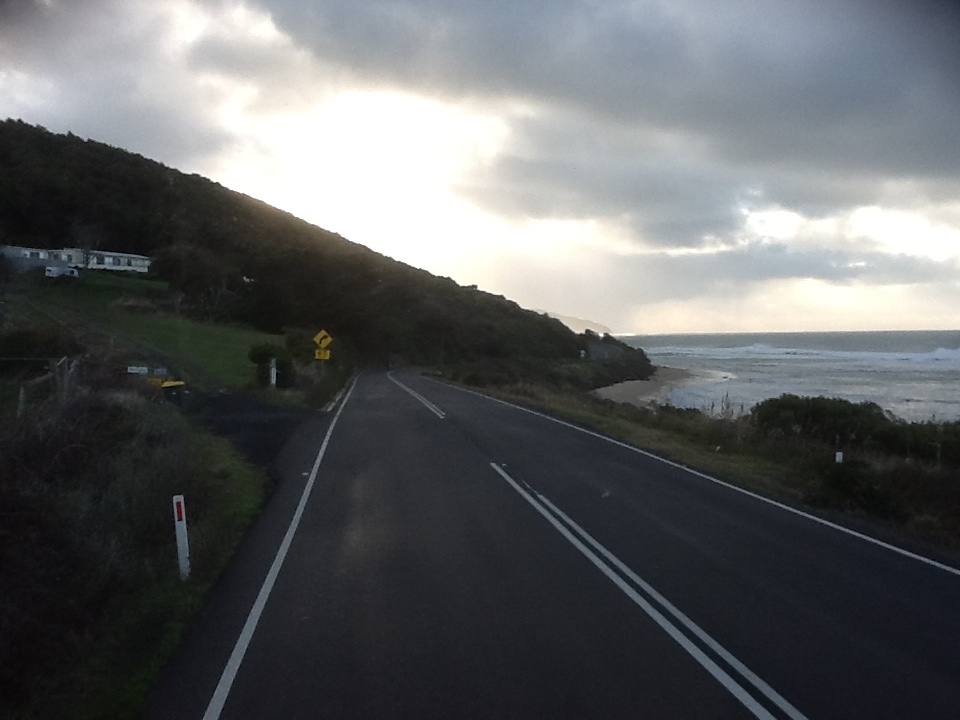
A quick photo out the front window – shame about the weather
Lorne, Anglesea and Torquay are the biggest towns on the way. Thankfully the rain stopped and we had a clear and partly sunny drive, and with very little traffic, looking out over the Southern Ocean, and down the side of cliffs on one side, and up the Otway Range on the other. Because it was so cold and the forecast wasn’t good, we decided not to stop at Torquay and the great Bells Beach, and rather, to skirt around Geelong and head north. This means we miss out Mornington Peninsula and the east coast of Victoria, including Lakes Entrance. We’ve decided that its just too cold this time of year, and so when we explore Tasmania in the future, we’ll include the coastal areas we missed out on this time.
From Geelong, we headed to Ballarat, which is about 105kms west-north-west of Melbourne . Now some of you may laugh, because the Victorian’s would say that this is the coldest place in the state! And yes, it was certainly cold, 7 degrees in the middle of the afternoon in the sunshine. But, we enjoyed it. Ballarat was first settled in 1837, and today some 100,000 call this city home. It became a gold rush boom town in the 1850s, and then made a very successful transition to an industrial age city from the 1860s. There are a number of heritage Georgian and Victorian buildings and mansions, luxury villas and terrace houses in excellent condition, as well as large and historic churches. The city has a very beautiful urban lake, Lake Wendouree, which is beautifully maintained, circled by a combination of boathouses, expensive yet tasteful homes and gardens.
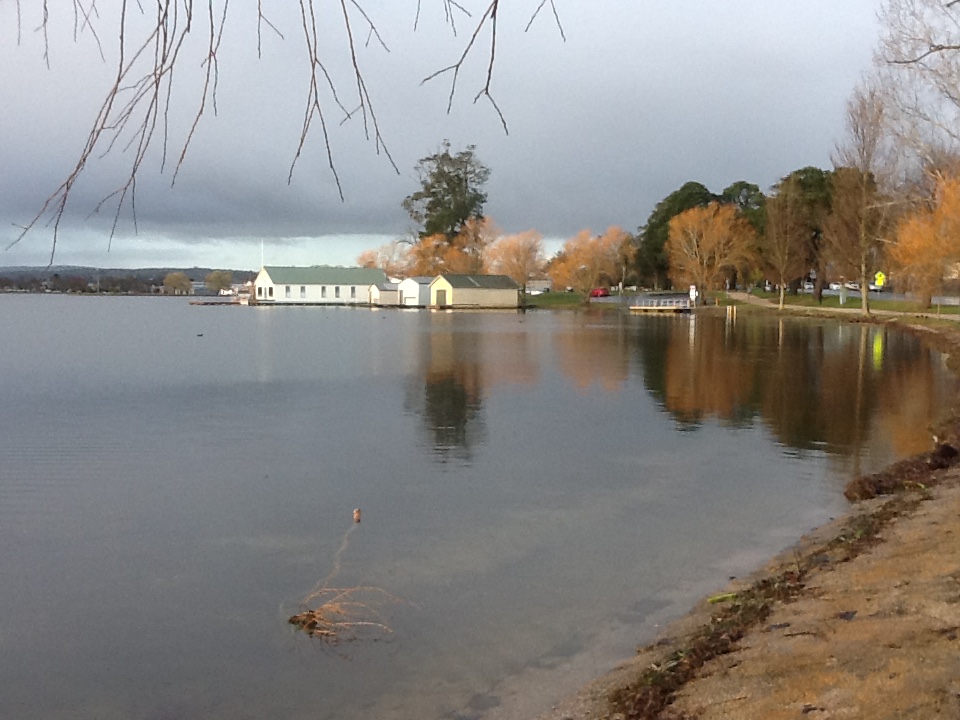
Boat sheds on Lake Wendouree
A major attraction for the city is Sovereign Hill, a recreated 1850s gold mining settlement, staffed by some 350 locals (some have been working there over 30 years), all in period attire, running the town just as it would have been. We spent a very enjoyable couple of hours in and out of shops, talking with staff and soaking up the history. They still make candles just as they used to, there is a blacksmith, carriage manufacturer, jeweller, several pubs, a school, constabulary, houses, etc, everything that would have been supporting a mining town.
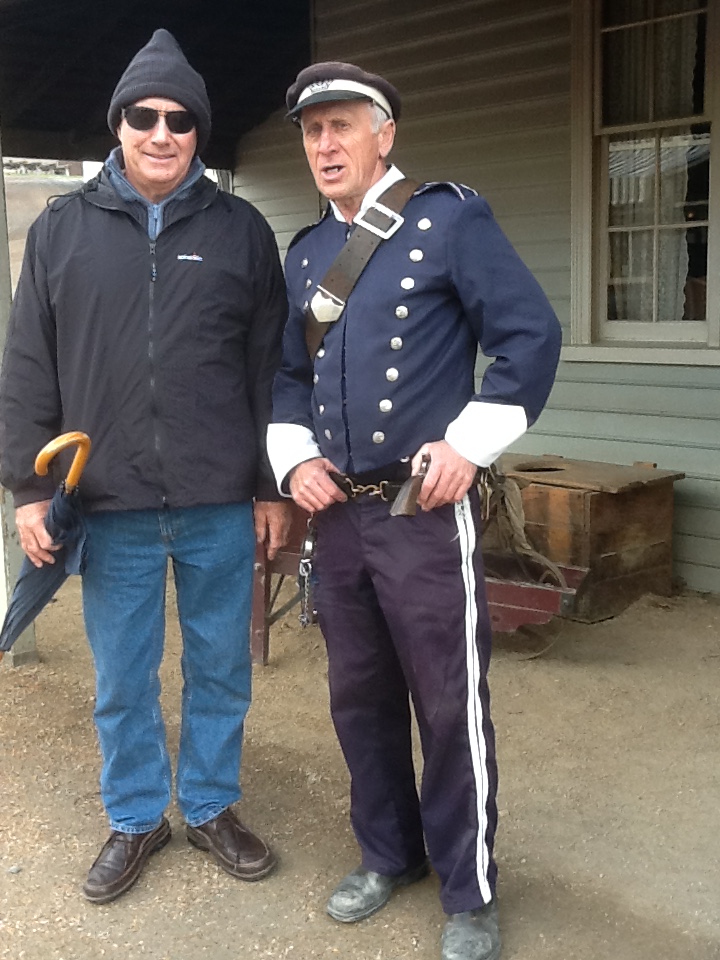
Chatting with the local constabulary, note the beanie!
They do it really well. We made Ballarat a one night stop. We must comment on the amenities where we stayed – because its so cold there, there is underfloor heating in the amenity blocks. Now that is a first for us!
When we left Ballarat it was 3 degrees and foggy….and stayed that way for about 50kms. Our plan had been to drive up the Midland and Calder Highways, through Daylesford and Castlemaine and on to Bendigo. Once we could see the scenery it was a very pleasant drive through an agricultural belt and some decent sized hills. We’ve been to Bendigo before, however didn’t quite recall how similar it is now to any small city, and so once we were there and driving through the city, it held limited appeal as a stop over so we continued on the Calder Highway 90kms to the historical town of Echuca on the Murray River, and just shy of the border with NSW. In the 19th century this was Australia’s largest thriving inland port city, with steam driven paddle steamers packed with wares, working their way along the river to the Port, where they were unloaded and transported by rail to Melbourne.

Paddle steamer from yester year
At one stage there were 15,000 living here, and they say there were some 100 hotels in the area. Today the town supports a population of 13,000, and it attracts many tourists who venture here to enjoy time on one of the world’s largest operating fleet of paddle steamers, including the oldest operating wooden hulled paddle steamer in the world. We enjoyed a stroll along the river, stopping at the Port, and wandered around and into many of the town’s galleries and shops. Its certainly an attractive little town for a stop over.
We knew we had to make a decision here. Did we continue up the inland route and into QLD, did we cut across to the coast, or did we go via Sydney so we could get The Tent serviced given she’s due one, and also catch up with friends, and then head north. A few phone calls, and it was decided, via Sydney. So, from Echuca we headed across the border, through Deniliquin, east to Finley and then north on the Newell Highway 150kms to the small NSW country town of Narrandera. Why here? We were catching up with Melbourne friends Graeme and Rene, whom we met 2 years ago in Cotton Tree QLD, as they embark on their trip north. There’s a lovely little peaceful camp ground overlooking Lake Talbot, and we parked up front on, overlooking the side of the lake, where we spent a quiet 4 days, 2 in the company of Graeme and Rene.
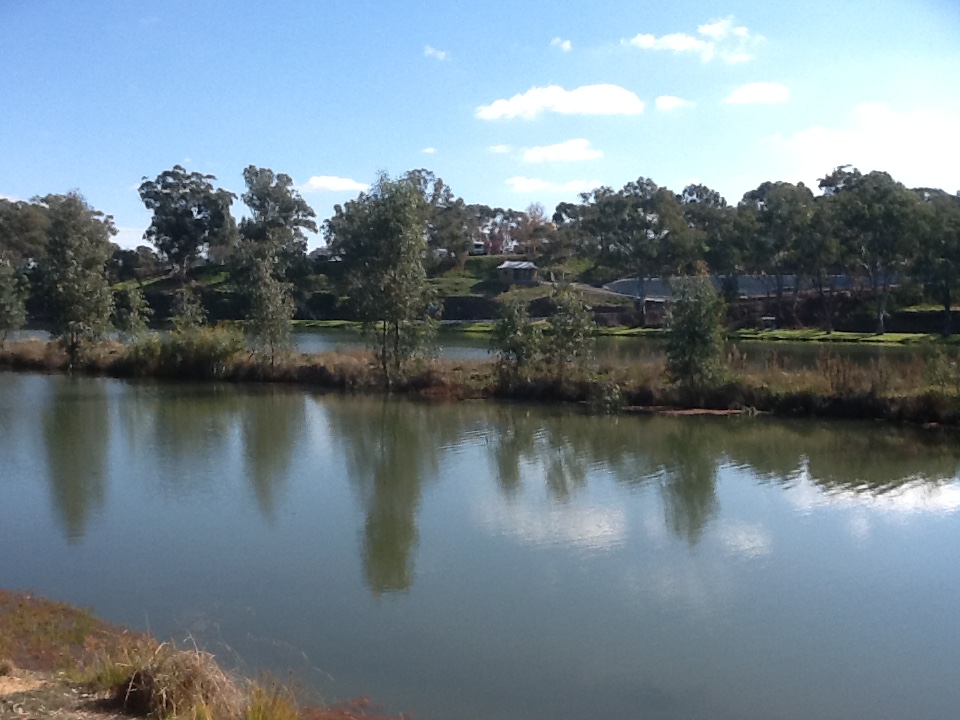
Looking out of the bus – across Lake Talbot,
We shared many laughs, enjoyed some good walks, and a glass of wine or two in the evening. We experienced our first(and subsequent) frost of the season whilst here. There’s a nature reserve just out of town, and beside the river and the lake, where 40 or so koalas were relocated a number of years ago. So we spent a few hours koala spotting in the trees – successfully I might add! Oh so cute.

I’m really cute – who are those people looking at me?
This morning we were on our way, traveling 290kms to Cowra, traveling through green fields, looking across rolling hills and lush farming land. There’s obviously been good rain in this region in NSW. We’re now just 260kms from Penrith, outer Western Sydney. This is another one night stop, staying courtesy of the local show grounds, very close to the centre of town. Cowra is located on the banks of the Lachlan River, and had its beginnings in the late 1840s. We tripped around Cowra this afternoon, in glorious sunshine, to hunt out some of the major sites of interest. What the town is well known for is WWII history. Cowra was the site of a POW camp, housing prisoners from Japan, Italy, and 3 or 4 other countries. On August 5, 1944 at least 545 Japanese POWs attempted a mass breakout, whilst others that remained simultaneously committed suicide, or were killed by their countrymen inside the camp. 231 Japanese died during the breakout. The site is today a memorial, with a replica guard tower and interpretive displays.

The replica guard tower
It is quite sombre, however an important memorial. Closer to town are the tranquil Japanese Gardens, 12 acres developed initially in the 1970s as a sign of thanks for the respectful treatment of the Japanese war dead, with a second stage opening in 1986. These are the largest Japanese gardens in the Southern Hemisphere.
Tomorrow we head east again to Bathurst, ready to drive over the Blue Mountains to Penrith on Tuesday, after the long weekend. Once we hit Bathurst we are back in very familiar territory. Google maps can take a break! Once there, that will complete our circumnavigation of the country. We are back at our start point.
 Jane and Steve's Travels
I’m in the UK until first week in July so I suspect I’ll miss your time in Sydney. How wonderful that you’ve been all the way round. Hopefully we’ll be able to catch up sometime. Keep in touch! xx