The delights of Karijini National Park

Last Thursday we left Port Hedland nice and early, heading for Karijini National Park. Because the road we travelled connects Port Hedland to Newman we knew we should expect lots of road trains commuting between the Port and the mine site. So, as you do, we decided to count the oncoming road trains and work out how many we passed each hour…..it was one every two minutes. So combine this with those in front of and behind us, and yes, it’s more than one a minute. Quite astounding, a very busy road. We were also fascinated by the number of dead cows on the side of the road – because many stations are not fenced due to cost, they risk loosing stock on the roads. Over 200kms there must have been at least 40 carcases, worth close to $40,000….a huge loss for the station owners!

Our first stop was at Albert Tognolini free camp, just off the highway and at the side of the national park. What a delightful stopover. We arrived before noon, and had a relaxing afternoon and evening enjoying stunning views across the hills and escarpments. It wasn’t too hard to handle.
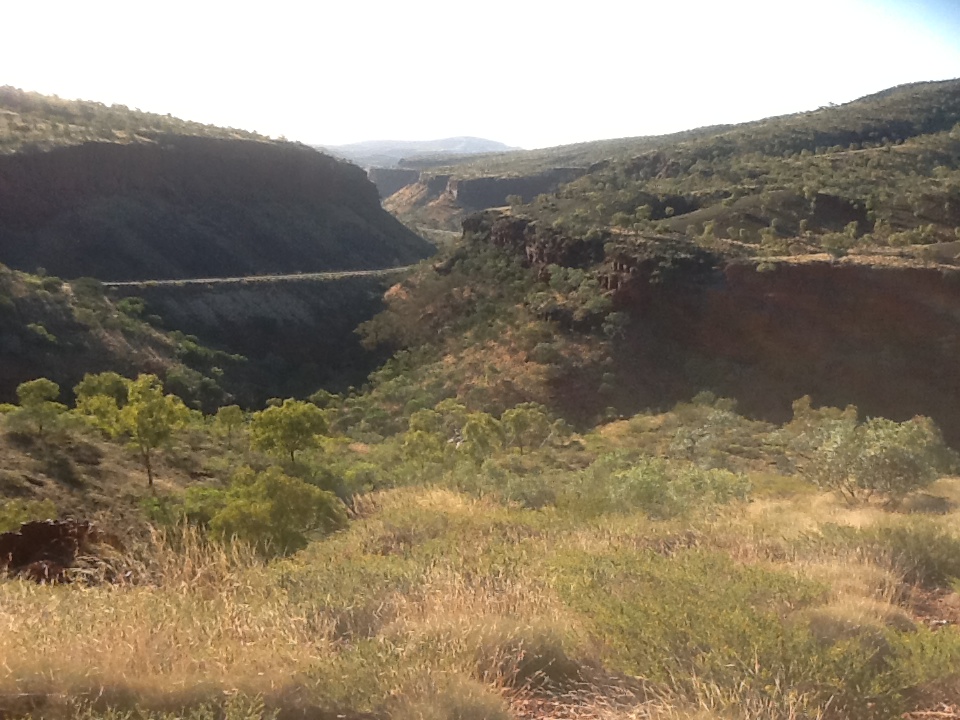
The view down to the highway from Albert Tognolini  free camp area

The view down to the highway from Albert Tognolini free camp area

Camping areas are well spaced so that no one needs to even be aware of their neighbours. Early afternoon we went for a walk and on our return were confronted by what looked like a road train coming up the hill…..and then it parked in the same area as us. We learned that this was indeed a camper, built in a semi trailer, owned by a lovely QLD couple Alan and Linda. Its amazing the range and scale of buses and campers we meet on the road!
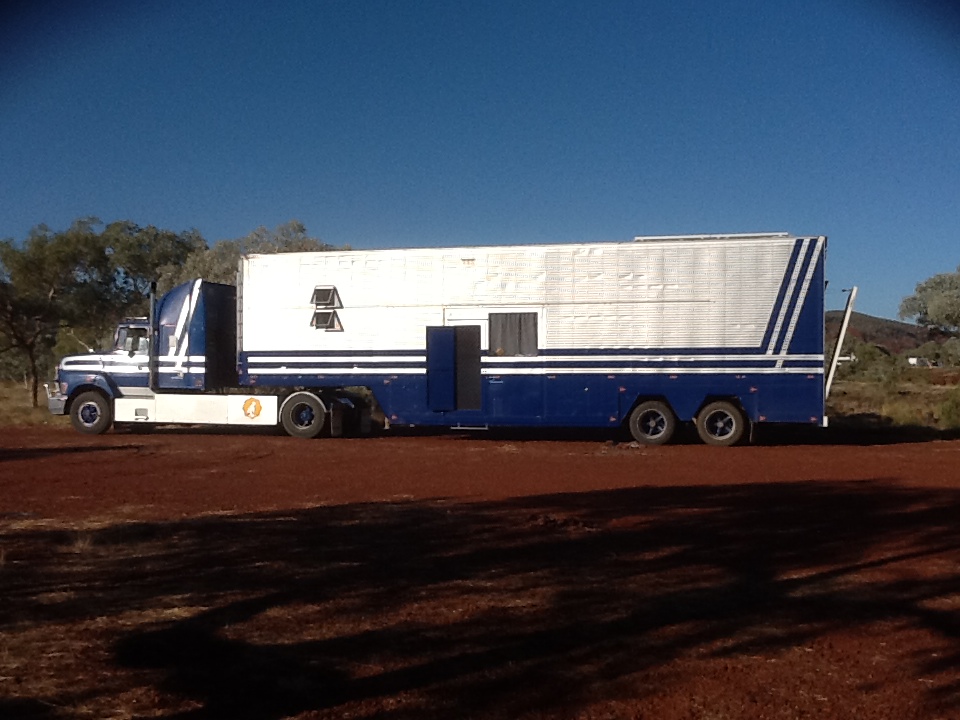
This huge semi trailer is actually a camper!

This huge semi trailer is actually a camper!

On Friday we ventured into Karijini to Dales camp ground. Thankfully this is a national park camp that is at the end of a sealed road. We were so lucky! There is an area that is designated for coaches (tourist version) and because there were none due for 5 days we were able to park here, a separate area from the rest of the camp ground. The sites are huge and well spaced, there are dedicated b’bcues and toilets and it is quiet. This was a fantastic spot, so much so we extended from 2 to 3 nights.

There are a number of gorges in Karijini and with 3 days we wanted to walk as many as we could. Karijini was formed over 2500 million years ago as iron and silica-rich sediment deposits accumulated on an ancient sea floor. When you drive into the park its easy to question ‘where are these gorges?’, because the landscape doesn’t look like there could be any! Small creek beds are hidden in the rolling hillsides, suddenly plunging down 100 metre chasms. These gorges become wider, with sheer cliffs changing to steep slopes of loose rock dropping down to dramatic waterfalls and clear fresh pools. Quite simply they are amazing. On Friday afternoon we walked to Dales Gorge, home of the Fortescue Falls, the Fern Pool and the Circular Pool.

Looking down on Fortescue Falls

Looking down on Fortescue Falls

We walked down to the Falls which are quite beautiful and after soaking up the atmosphere walked 300m along to the Fern Pool. Wow, this is a glorious and large fresh water pool at the bottom of low falls, surrounded by ferns and trees creating a tranquil oasis that is hidden away from the main event. We just had to have a swim despite the fresh cool water! It was beautiful, but just a little fresh. I wonder why we were the only ones in the water!
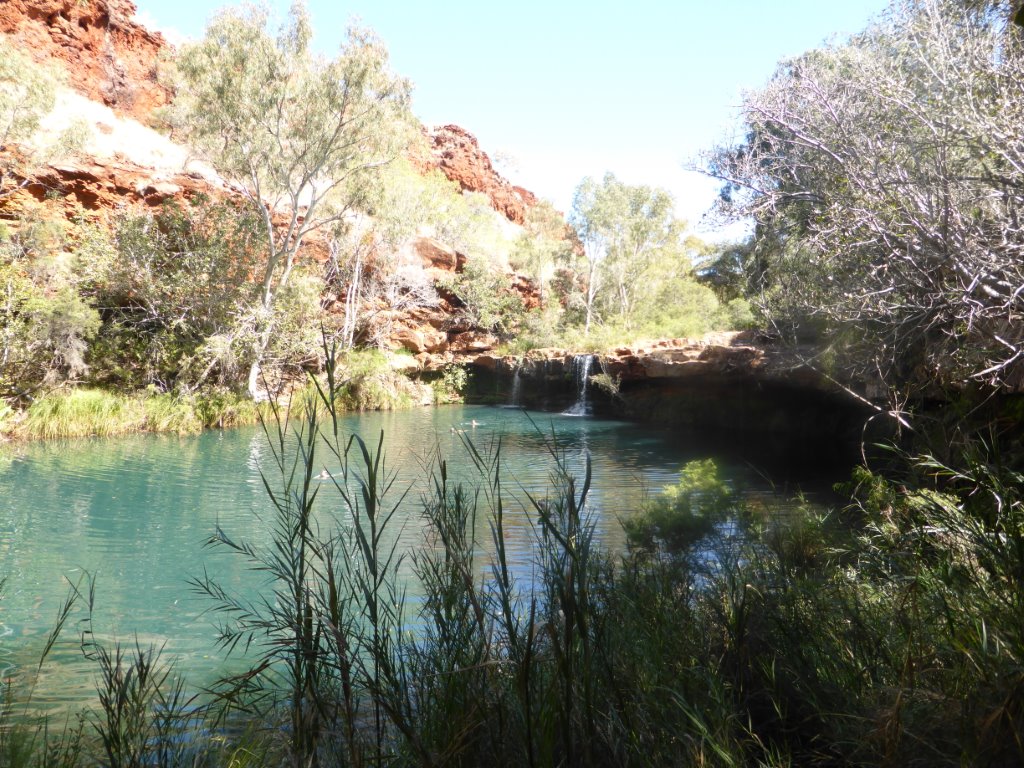
The Fern Pool

The Fern Pool

Following a light lunch, it was down into the gorge, to walk through to the Circular Pool, a kilometre downstream. After a scramble back up the cliff face, and a stroll back to base, we relaxed for the rest of the afternoon, planning our jaunts of the next two days.

Over the next 2 days we visited and conquered Knox. Joffre, Hancock, Weano and Kalamina Gorges. The first four of these are class 5 trails – that is difficult with a high degree of fitness required….we must be fitter than we thought! Each gorge has its own beauty. Knox has a very steep descent, with lots of loose scree, and the meandering waters and pools in the gorge lead to a narrow pool at the end that is just made for skinny dipping.
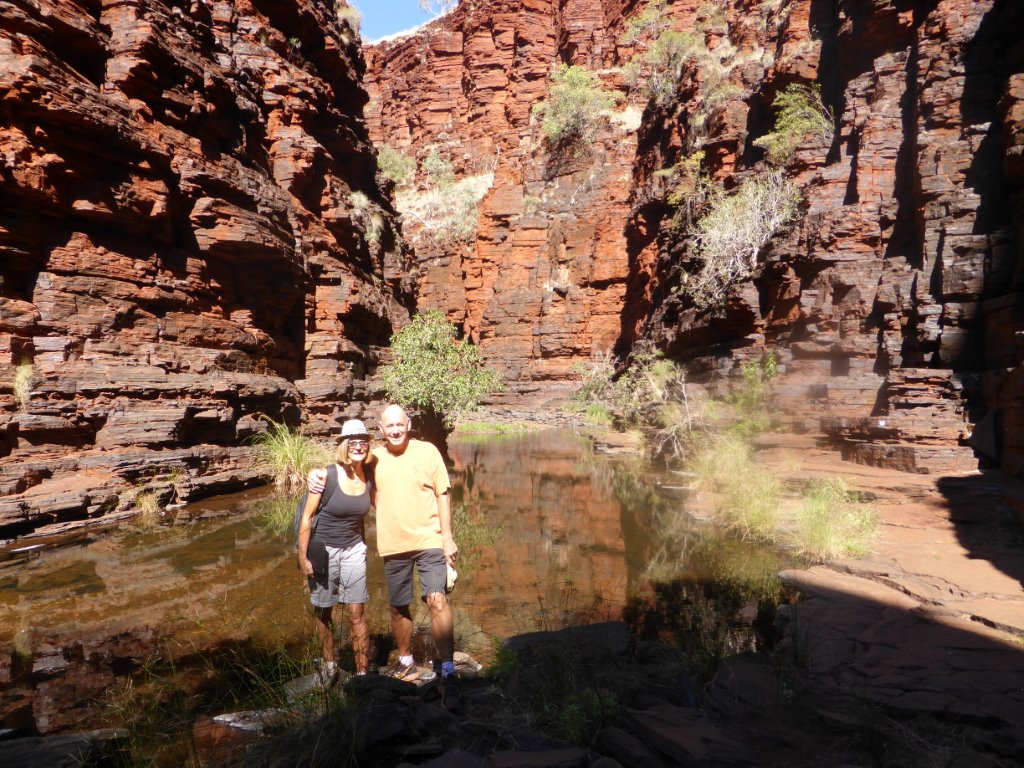
The bottom end of Knox Gorge

The bottom end of Knox Gorge

There was no one else there so I just had to jump in! Brrrhh, it was a bit chilly.


Hancock has the crazy spider walk, leading to Kermits Pool.

Jane doing the spider walk in Hancock Gorge

Jane doing the spider walk in Hancock Gorge

We had heard about this gorge. Its a rapid descent into the gorge, followed by thigh high pool crossings, that lead to the spider walk through a 50m very narrow water filled chasm, cliff climbing using small hand and foot holds, ending at Kermits Pool. We were a bit sceptical about the spider walk – could we do it? Yes we could! Our muscles had a good workout, and despite being a little wet we had big smiles on our faces as we climbed back out of the gorge on to our next venture, mastering Weano Gorge. Weano Gorge is deceptive, it is an easy climb down to the gorge itself, and you can take a relatively easy walk through the gorge, or you can tackle more water, clamber along rock faces using tiny hand and foot holds, and then gingerly walk along very smooth rock to the Handrail Pool – which is a deep pool reached by climbing down rock steps, straddling the handrail.
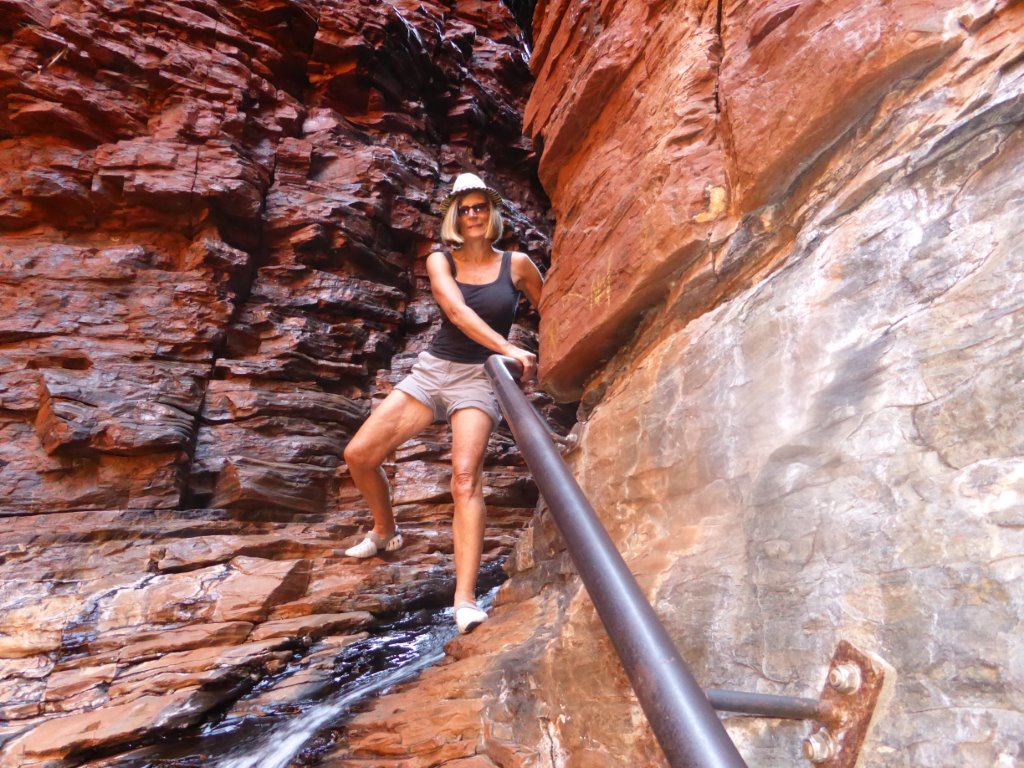
Jane climbing down to the Handrail Pool

Jane climbing down to the Handrail Pool

And it doesn’t end there. If you are brave enough, it’s into the icy cold water for a swim through a long and narrow chasm to another pool. Fantastic but cold!  And then you have to get back again and climb the rock face back out of the gorge. And yes we didn’t take the easy option! Phew, lots of energy expended but so much fun!

Our last day at Karijini was light in comparison to the earlier days, with just a walk through the Kalamina  Gorge. We knew it would be a little easier given it’s a class 4 trail. Down the escarpment to the gorge floor, the walk criss crosses the bubbling waters of the streams, and there are only a couple of scrambles along rock faces, before arriving at the pool at the end of the gorge.
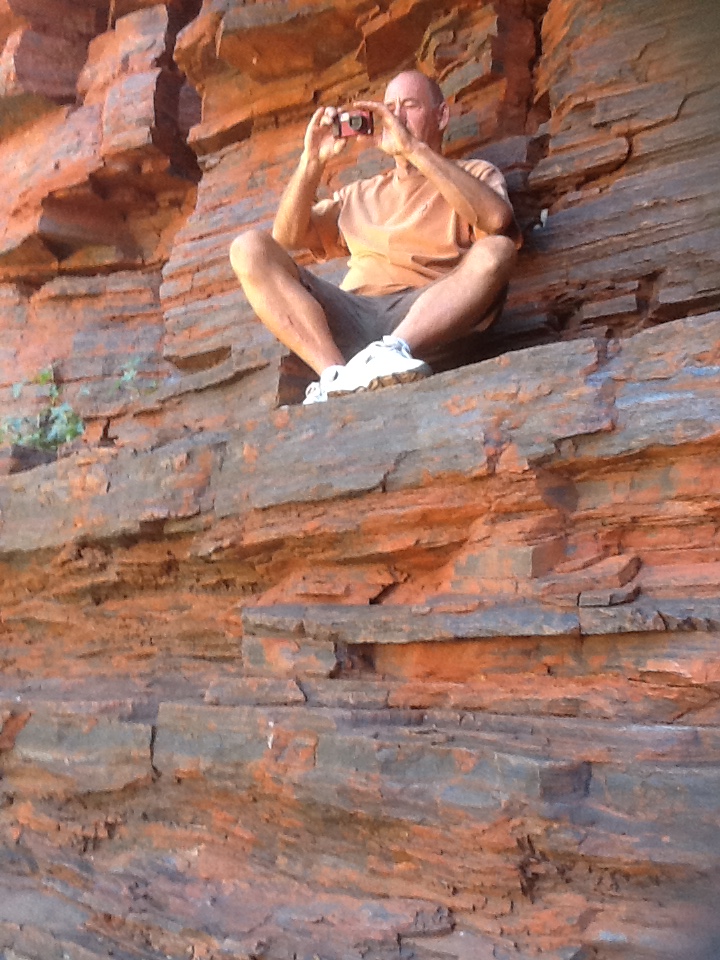
Steve taking a photo before climbing through 'the window' at Kalamina Gorge

Steve taking a photo before climbing through ‘the window’ at Kalamina Gorge

To get to the swimming pool there is a cliff climb through a ‘window’. We didn’t swim, choosing rather to enjoy the scenery and peace and quiet of the morning. We had the gorge to ourselves for most of the walk. Unfortunately on our way back to camp we got a puncture, and Mr McGiver had to get his tools out and make a swift change back at base.

It was hard to leave the scenic beauty of Karijini, which had been a real surprise to us and it’s clear that it’s not well publicised. We wouldn’t have detoured to the park if it wasn’t for fellow travellers who shared their experiences and noted it as a must visit destination.

On Monday morning we hit the road, with our first stop of the day planned for Tom Price, a Rio Tinto mining town that was established in the early 1960s when iron ore was discovered by the American Tom Price. We needed to get our Suzuki puncture fixed and were lucky enough to get it done straight away at the first place we tried. After a quick look around we hit the road again. Some 400kms later we stopped for the day, and travelled the last 200kms on Tuesday morning. Now I have a confession to make. As the chief navigator it’s my responsibility to book camp grounds when we choose to stay in them. I duly met my responsibilities for Exmouth and booked the camp ground…..but it was the wrong one. We rocked up to the Ningaloo Lighthouse Caravan Park to be told we had no booking. Not good! And the driver wasn’t too happy. So some quick footwork and conversation and thankfully we had everything sorted and have booked for a week here. We’re in the overflow area in the best spot, with beach and sea views and our own amenity block….and there’s just us and one other van! How good can it get. We have a whole week to play in this world heritage area that offers snorkelling on the reef, swimming with whale sharks and beautiful clear waters for swimming. What a week! And here’s a wee tempter….
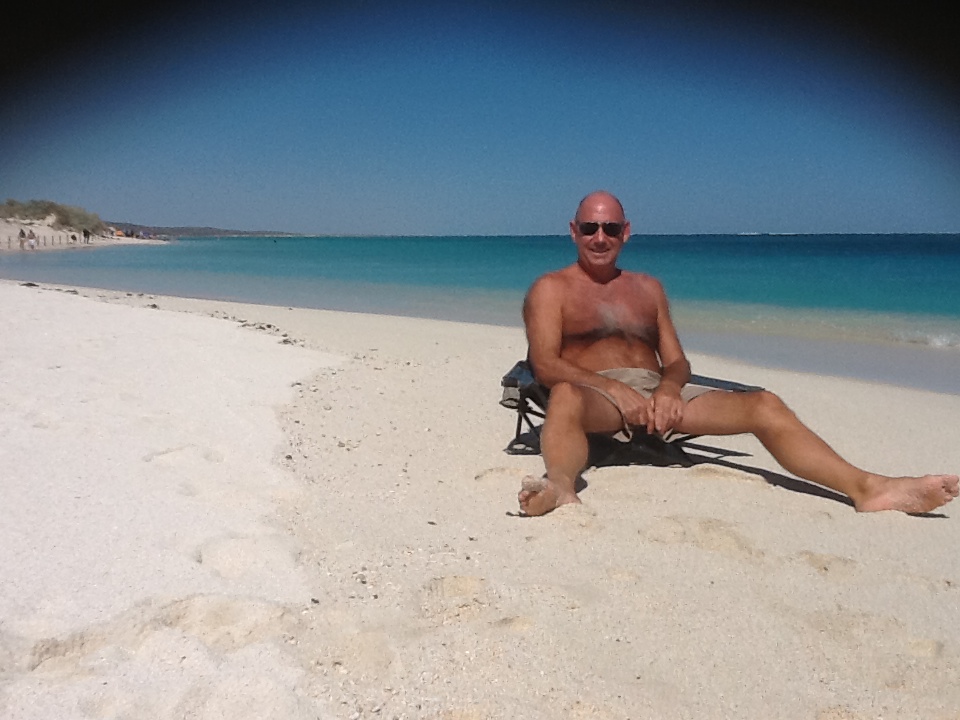
Steve enjoying the tranquillity of Turquoise Bay, Ningaloo Reef, this afternoon

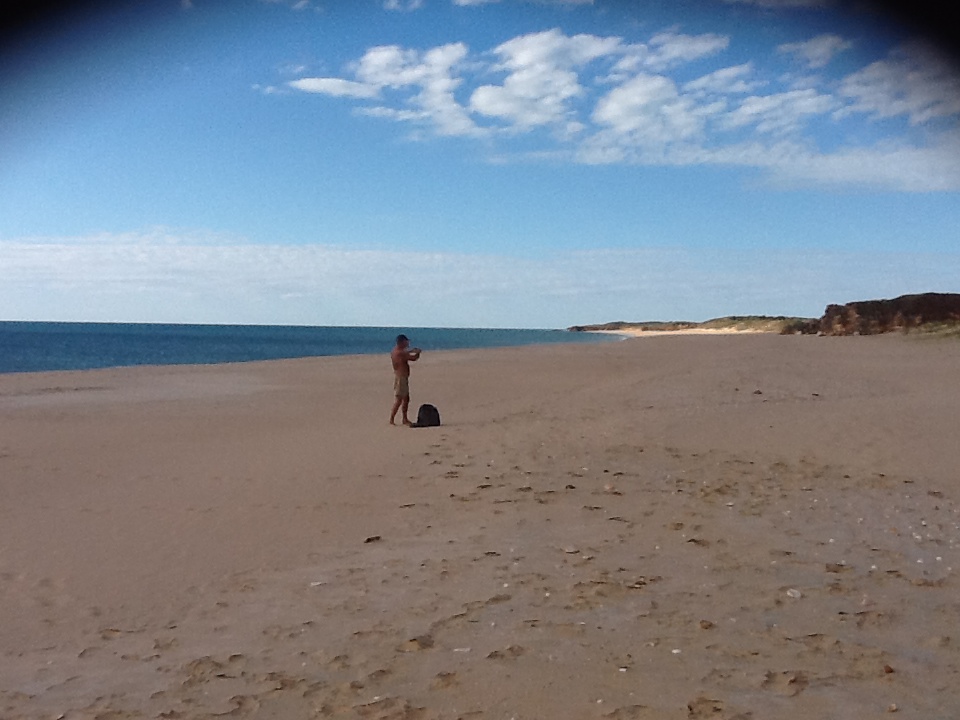
Steve enjoying the tranquillity of Turquoise Bay, Ningaloo Reef, this afternoon
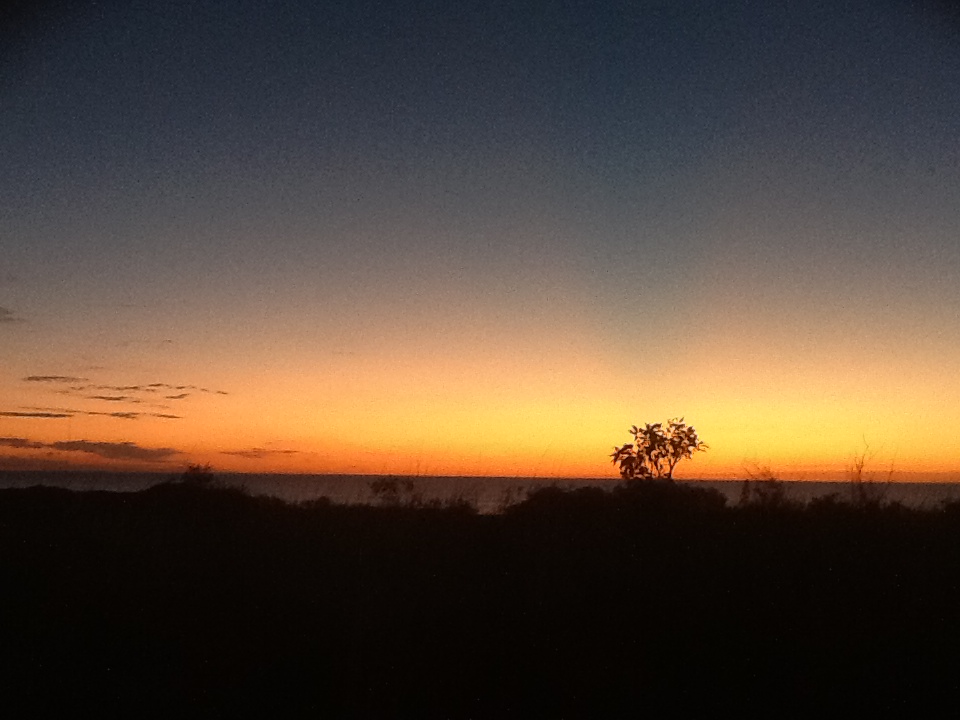


Broome to the mining town of Port Hedland

We originally planned to leave Broome last Thursday, however we had to wait until Friday for mail to arrive and with friends Rod and Dearne ‘in town’ we made the decision to stay until Saturday morning. It wasn’t too hard a decision given the company, the sunshine and lovely beach for swimming. We had a very social few days, joining Rod and Dearne and their friends Lyn and Bruce from the east coast for lunch on Wednesday, dinner out on Thursday at a local restaurant and again on Friday night at the Broome fishing club.

Rod, Dearne, Lyn, Steve, Jane and Bruce enjoying a wine watching sunset in Broome

Rod, Dearne, Lyn, Steve, Jane and Bruce enjoying a wine watching sunset in Broome

We could have become quite accustomed to this lifestyle and the good company however after almost 3 weeks we opted to head south on Saturday morning.

We weren’t quite sure where we would be at the end of the day because both places we wanted to visit meant taking red dirt and corrugated roads, which are not ideal for ‘The Tent’. Barn Hill was the first consideration, some 130kms, a relatively short trip. We had made the decision we would park the bus and take the car down the 9km road and see what we thought. Five minutes after setting off Steve met 3 caravans on their way out and the verdict was ‘you’ll eat it if you take it slow’. So that’s what we did. The road was manageable driven at 20kmphr and being vigilant. We weren’t sure what to expect, other than what friends Therese and Kerry had told us how lovely the beach was….and we weren’t disappointed! Barn Hill is a 450,000 acre cattle station along the coast between Broome and 80 Mile Beach. It is quite an isolated camp, with a truly magnificent beach overlooked by rugged red rocks and cliffs .

Enjoying the deserted beach at Barn Hill

Enjoying the deserted beach at Barn Hill

The camp ground overlooks the beach and out to sea.

Sunset over the sea, from 'The Tent', Barn Hill

Sunset over the sea, from ‘The Tent’, Barn Hill

We are convinced we had the best spot in the park with stunning views right along the beach and back up to Broome, so it was easy to make the decision to stay for 3 nights. Many beach walks and swims were enjoyed.

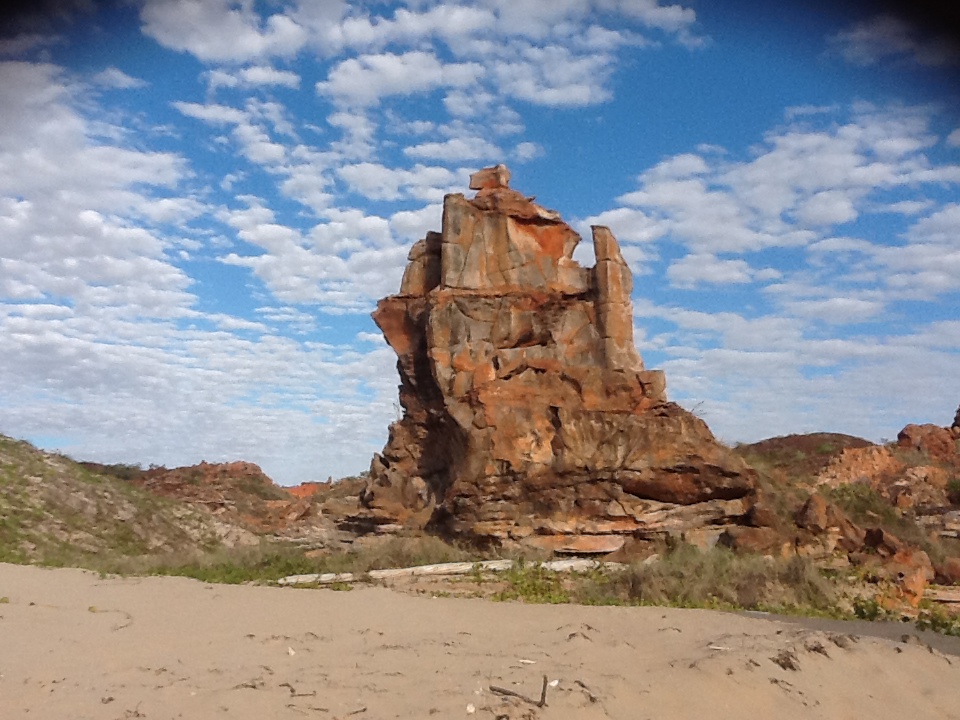
Unusual rock formations at Barn Hill

Unusual rock formations at Barn Hill

Being able to walk the beach with no one else in sight is quite something given there were several hundred campers at the station. Yet it is certainly possible. For a less commercial caravan park that isn’t expensive they make a real effort, providing a very cost effective 3 course meal and entertainment on a Sunday evening, which we very much enjoyed.

On Tuesday we hit the road again. We had planned to go to 80 Mile Beach, however it was very windy and forecast to be today also, and we didn’t fancy being battered by sand and red dust, so headed on toward Port Hedland, making an overnight stop at Pardoo on the way and arriving here mid morning today. At Pardoo we met a fellow kiwi (John an extremely fit 62 year old) who is riding his pushbike from Darwin to Perth in less than 10 weeks because he needed a challenge! And amazingly he works for the philanthropist Julian Robertson in NZ, and as some of you may know my brother is Julian’s CEO. And John’s sister lives at Oneroa, his brother lives at Whangaparaoa and he lives at Havelock North near Napier. He is also a keen sailor and a member of the Napier yacht club and Steve was a member in 1973. The coincidences were amazing.

We originally thought we might spend two nights in Port Hedland……but have revised this to just the one. Port Hedland is a mining town that services the local mines and port activities. There are 3 main areas which are typically referred to as Port Hedland. There is the port itself incorporating the city and beach suburbs (Port Hedland); South Portland which is residential; and Wedgefield which caters for light industry.  Port Hedland is one of the world’s largest and busiest working harbours with a 24×7 shipping operation moving over 158 million tonnes a year, and $100 million in daily iron ore. It was really interesting to see the port activities and just how incredibly busy it is, however other than the port, rail yards and salt works there really isn’t a lot to see – its very industrial, and of course strategically very important to Australia’s economy.

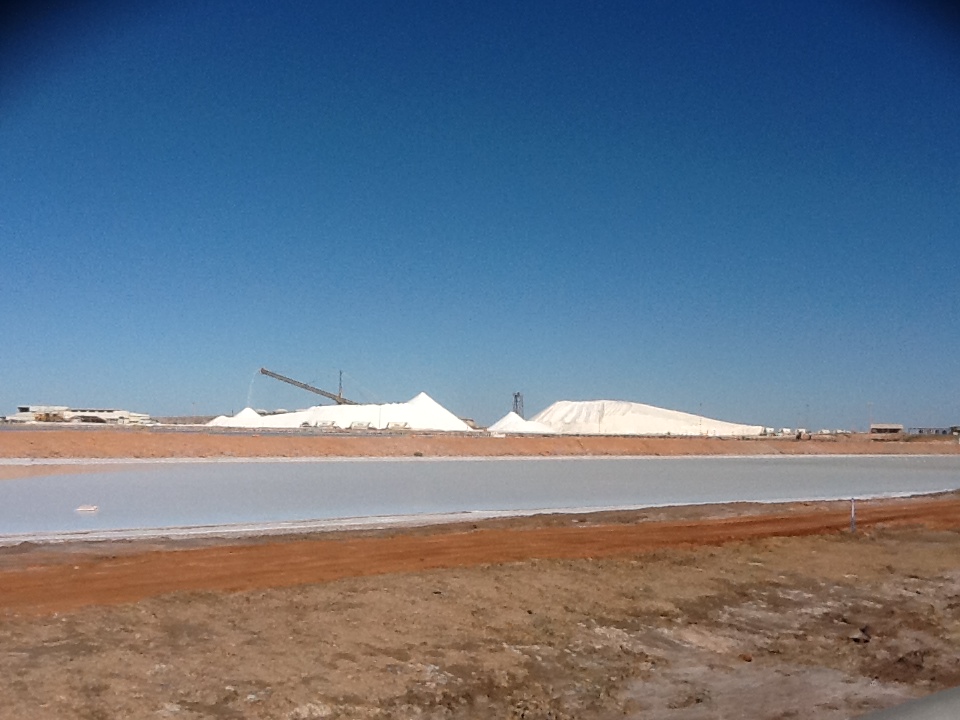
Rio Tinto's Minerals - salt works in Port Hedland

Rio Tinto’s Minerals – salt works in Port Hedland

This is though an expensive place to live, and there isn’t a lot on offer for visitors. The camp grounds are geared for miners and are over priced. So once we had watched port operations, we toured Port Hedland, enjoyed a bite to eat at the historic Esplanade Hotel, stocked up, finalised our chores and said ‘let’s hit the road tomorrow morning for Karijini National Park’. So tomorrow we hit the road again for the next adventure.

Our last week in Broome

I have to say that our last week here in Broome has been rather casual. We have spent our time between enjoying the delights of the beach, pottering around the township to find points of interest, bike riding, walking, chores and socialising with other campers. The weather has continued to delight, albeit yesterday was a wee bit warm at 35 degrees. Typically it is around 30 degrees, which is just right.

The old town of Broome, Chinatown plays a major role in modern Broome. Today it is the hub for many pearl shops from the areas local waters. You can’t help but imagine what the town must have been like back in heyday of Broome’s pearling industry when the town’s many pearlers that came from far and wide (Japan, China, the Philippines, Indonesia and Europe) would arrive back on shore, cashed up and head for the opium dens, brothels and billiard halls of Chinatown. Of course its not at all like this today!

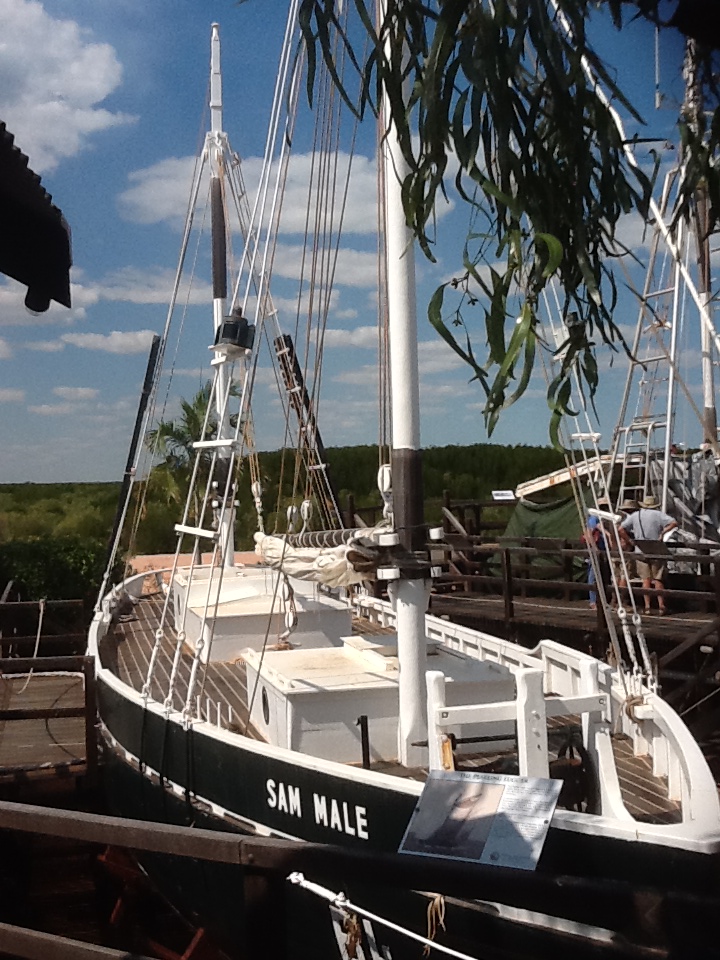
The old lugger Sam Male

The old lugger Sam Male

Several of the old luggers, Sam Male and DMcD that were used by the pearlers have been restored and rest at Pearl Luggers in Broome, alongside the tidal jetty and authentic pearlers store. At its peak before the first world war there were 403 luggers operating out of Broome and around 3000 divers. The conditions that the pearl divers worked in is hard to imagine back in the 1800s. Aborigines were captured and made to dive. The death toll was high due to sharks that cruised the estuaries where they frequently dived. When we think about how we dive today and what our dive equipment is like, and then compare it to what the divers put up with it makes sense that so many lost their lives – relying on the crew to keep air piped through hoses; lead shoes for weights; a metallic diving helmet; a canvas dive suit; and lead weights around the chest and back in addition to the shoes. We have certainly come a long way! With our dive and swimming passions we have managed to spend just a little bit of time around Chinatown – and of course I have sneaked into the occasional pearl shop for a quick look.

Yesterday, like many other days we drove many kilometres down the beach to peace and quiet and enjoyed an afternoon swim and walk.
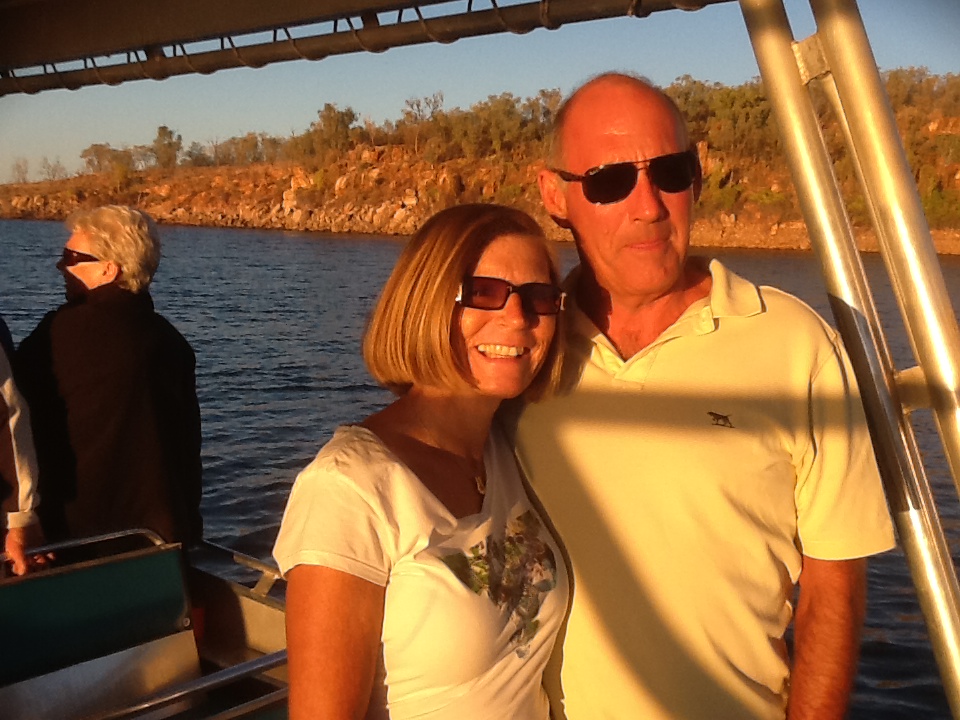
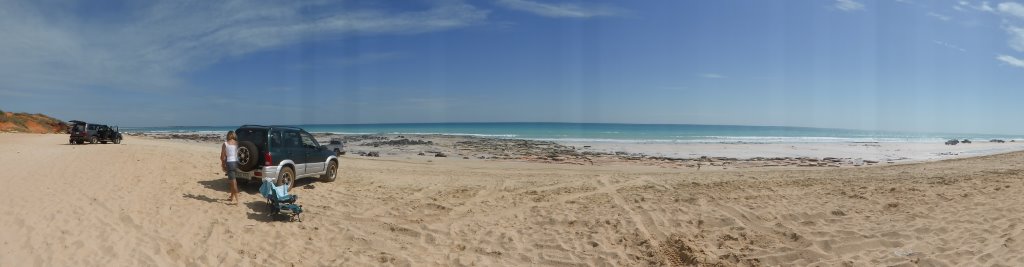
A deserted bit of Broome beach

A deserted bit of Broome beach

When we first arrived here we were rather surprised to find ourselves walking and driving among nudists – then we learned that right along this stretch is designated a nudist beach. Given that many of the 4 wheel drive vehicles belong to baby boomers you can just imagine what a pretty sight this isn’t! I guess when you get older you don’t worry what others think! Thankfully we haven’t quite arrived at this stage.

Broome, like many other more isolated Australian towns has a strong community and lots happening. Last Saturday it was speedway – Steve enjoyed this; last Friday it was horse raising on the dirt track – and again this weekend, a real attraction on the WA social calendar; in two weeks time its rodeo weekend; and we have seen gala balls promoted; music evenings and much more. Its fantastic to see. With its sunny winter climate, beautiful beaches where you don’t have to fear the infamous crocodile sneaking under the water, and excellent community spirit we can understand just why it is so popular at this time of year.

But alas, we have lots more to see and do before our traveling time ends, so in the next few days we will head south for our next adventure. Oh and I couldn’t resist including this photo.

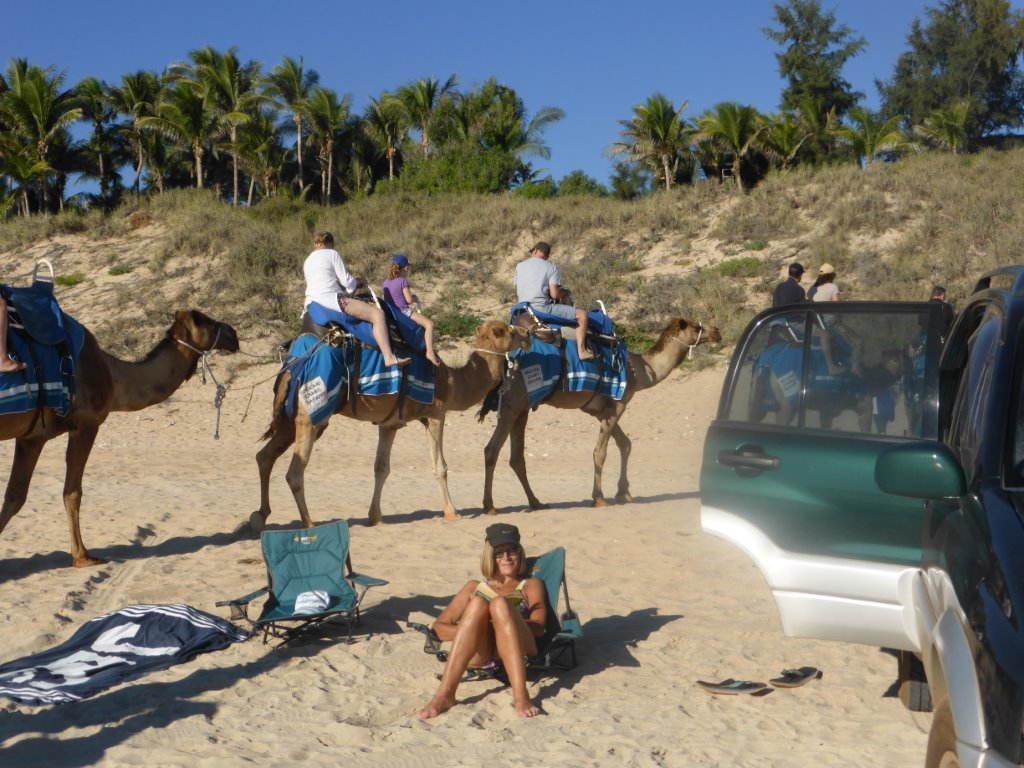
Peace and quiet no more - the camels have arrived!

Peace and quiet no more – the camels have arrived!

The other day I was quietly reading on the beach after a swim, and found myself surrounded by those pesky camels that the tourists seem to love so much.

Our time in Broome

We have now enjoyed a week in the seaside town of Broome, north West Australia. Broome is a real tourism hub for this region, with its warm temperatures, beautiful beach and warm seas.

Broome Beach

Broome Beach

We are very much enjoying our time here, having pottered around the little township, investigating Chinatown, the history of pearling and the old pearl luggers and the waterways. We were very lucky to arrive during full moon, to see the natural phenomenon of the “Staircase to the Moon” that occurs when the full moon rises over the exposed mudflats of Roebuck Bay at extremely low tide. This creates the illusion of a staircase reaching up to the moon. The Kimberley Coast has the biggest tides in the southern hemisphere, with the difference between high and low tide as much as 10 metres, thus low tide can expose a significant amount of mudflat when the tidal movement is at its greatest. We, along with lots of others positioned ourselves at the right place and time, armed with cameras to watch this special effect….and it was quite beautiful. But alas, unless you have an amazingly good camera when you photograph it, all you get is a black screen and some strange looking light spots, not at all what you see with the naked eye. So, disappointingly, no photos to share!

On Thursday we journeyed to the Horizontal Falls, the only 2 waterways in the world that run horizontally. David Attenborough describes these as ‘one of the greatest natural wonders of the world’. With a 5.45am pickup in the luxury 4×4 Bus ‘Big Foot’, off we ventured.

The 4x4 beast

The 4×4 beast

We (J&S and Kerry and Therese) were prepped and ready for our early morning flight – imagine our puzzlement when we went the opposite way than the airport, and started our journey by road. The trip was an all-dayer, a combination of fly, road and boat. We learned we were the group starting by road (the opposite of what we had expected), however we were really pleased…..the first part of the trip is by road up the Dampier Peninsula to Cape Leveque and much is still dirt, and they say, usually fine to travel at 90kmphr. However, with recent rains on the Peninsula dumping some 200mls, the road is very rutted and corrugated and from our Bungle Bungles experience I don’t need to tell you what that feels like! Even in this especially built 4×4 bus we felt the bumps! We were last on and had to sit in the back seats, so it was a bumpy way to start the day, but better that than at the end of the day. On our way up to Cape Leveque we stopped at Beagle Bay, an aboriginal community, Kooljaman (world renowned wilderness camp, famous for its red cliffs meeting the pristine white sandy beach and crystal clear waters of the Indian Ocean) for a light breakfast and One Arm Point, another aboriginal community and where we both visited an aquaculture hatchery and jumped on board the seaplane to Talbot Bay, home of the Horizontal Falls.

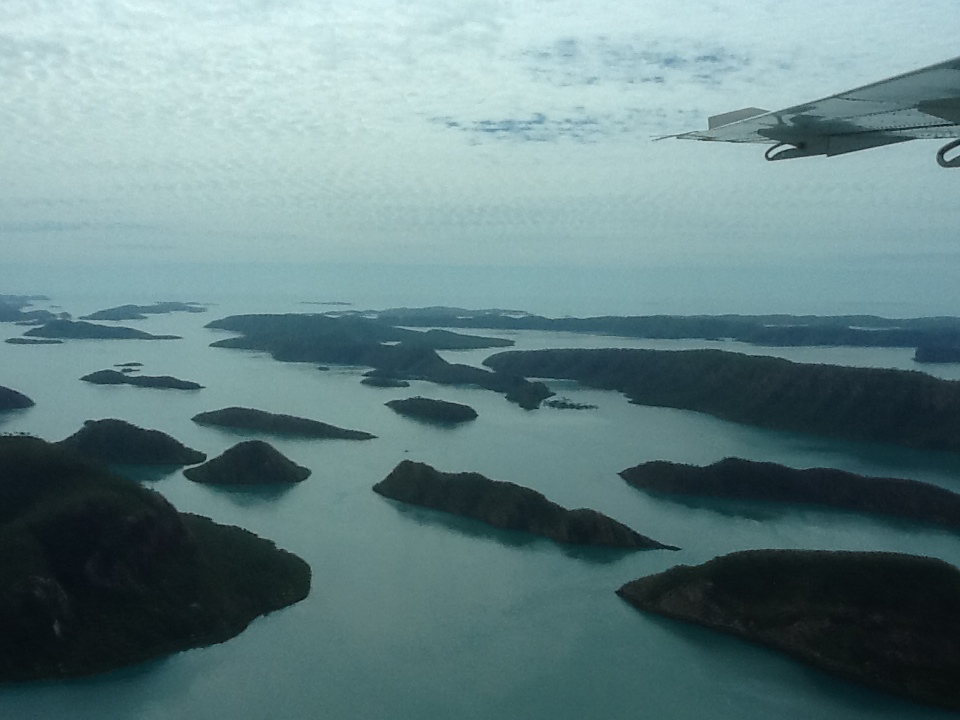
The seaplane trip seemed to be over in a flash. We flew low level over the stunning 1000+ islands of the Buccaneer Archipelago.

The islands of the Buccaneer Archipelago

The islands of the Buccaneer Archipelago

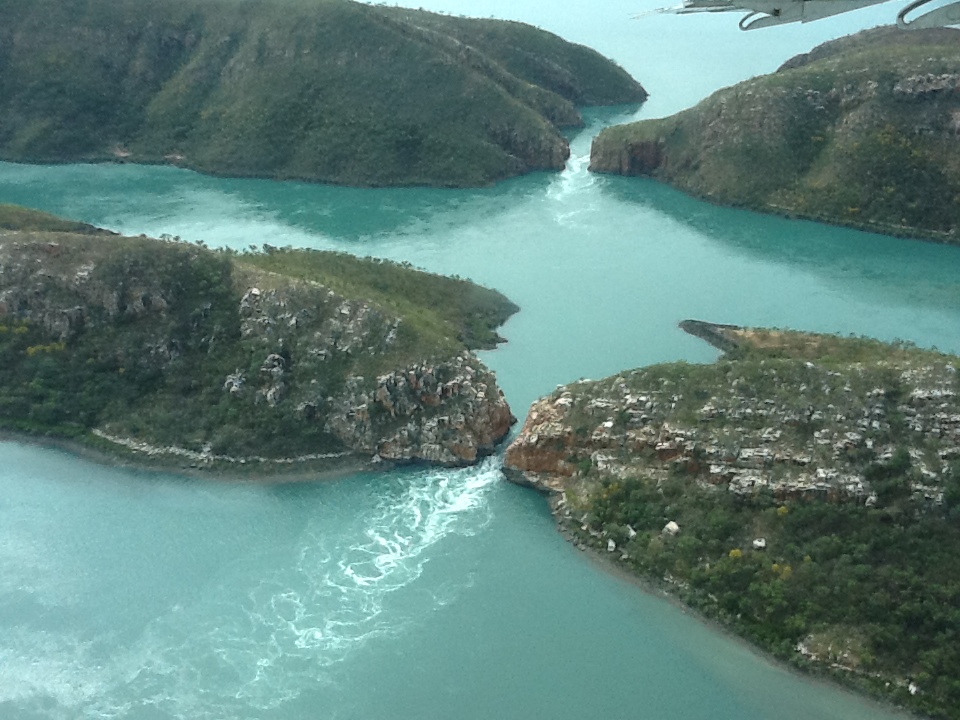
What a magical vista from the plane, so picturesque with vibrant turquoise seas, islands of all shapes and sizes and quick running seas with whirlpools and little waves whipped up by the ferocity of the tidal movement. The conditions here caused havoc with the pearl fishermen last century and many sailors and divers lost their lives. Oh what an amazing waterway to sail in, with lots of inlets, rivers and bays to anchor in. After 30 minutes there were the falls, the twin gaps that are part of the McLarty Ranges with their two parallel ridges approximately 300m apart.

Looking down on the Horizontal Falls

Looking down on the Horizontal Falls

The most seaward gap is ~20m wide and the second and most spectacular just 10m apart. The view from the air confirms just how small these gaps really are.

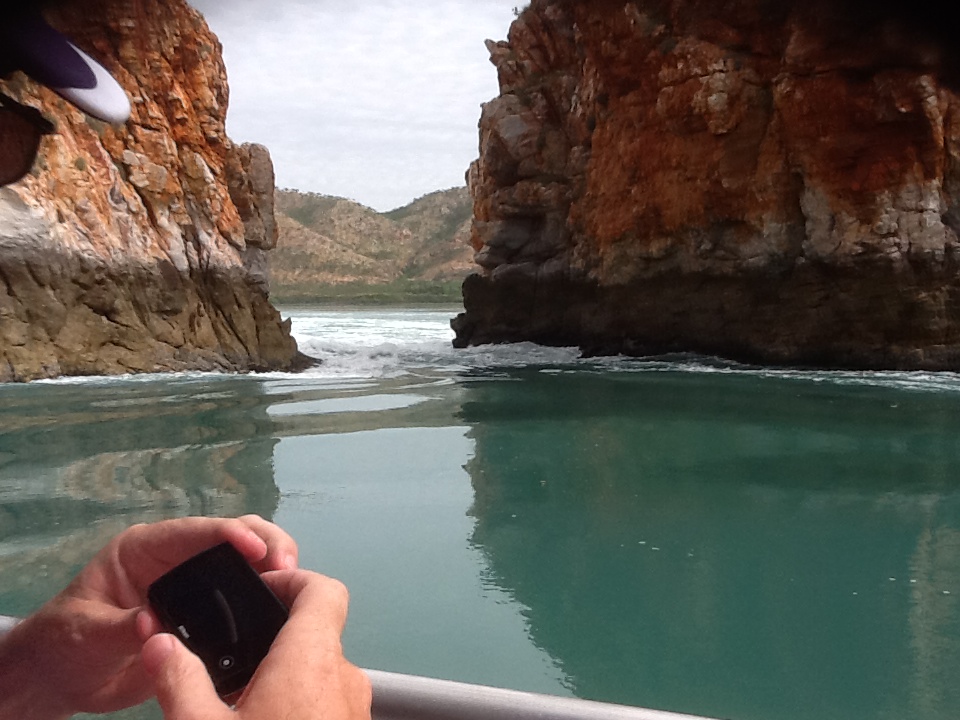
We flew in to a pontoon that houses overnight guests, a restaurant, helicopters, speed boats to the falls, a shark diving cage and all the supporting services and facilities. During the very enjoyable afternoon we did 2 exhilarating trips to and through the falls in the 900hp ‘beast’. With the speed of the tidal flow it is a feat of control and driving for the skippers of these boats. We have several videos of charging through The Falls, however sadly cannot post them into the blog.
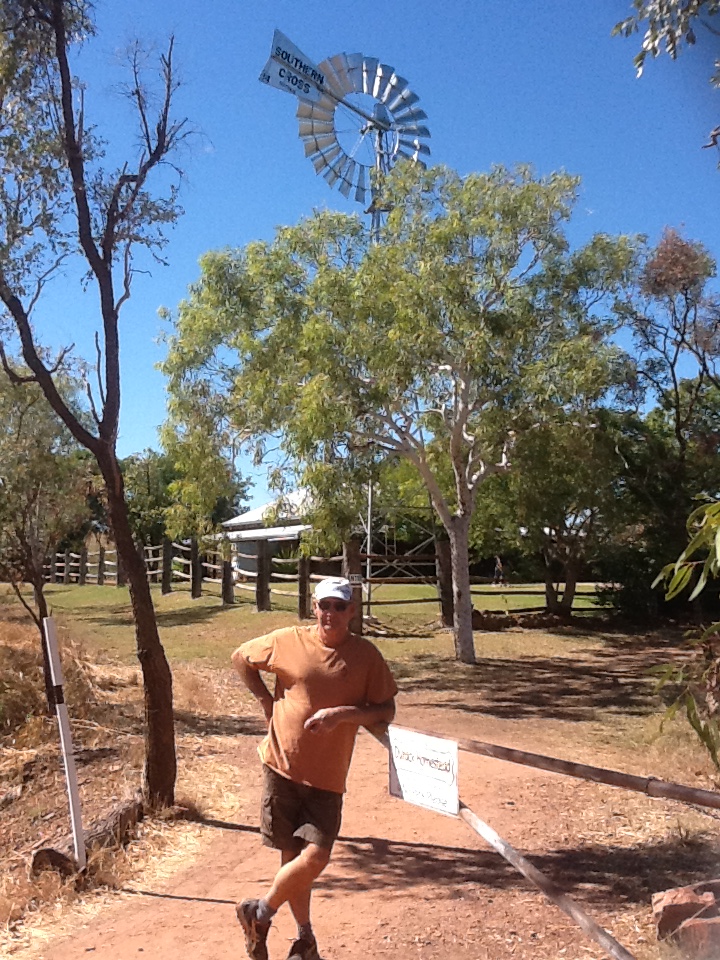
The Horizontal Falls, looking into the 10m gap

The Horizontal Falls, looking into the 10m gap

After a lunch of fresh barramundi, we enjoyed a dive in the shark cage (the sharks are pretty harmless) which was an excellent cooler, and then took a ride up into Cyclone Creek, a long and very sheltered waterway that runs between stunning red bluffs and escarpments, yet still demonstrates dramatic whirlpools and strong waterflow given the extreme tides. This is where the pontoon and boats are housed during the hurricane season.
To cap off the day we enjoyed a one hour seaplane trip back to Broome. And did we have fun – yes we did. Hopefully you can enjoy the spectacle through some of the photos in the blog.

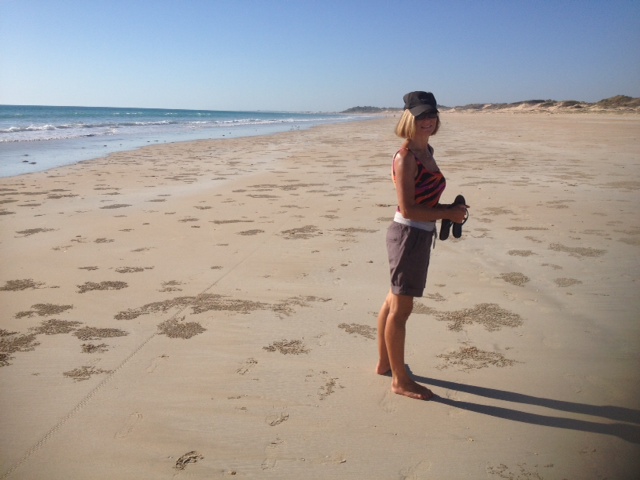
We have enjoyed long walks (and swims) on the 22.5km white sands of Broome Beach, sometimes driving down onto the beach where 4 wheel drive vehicles are permitted.

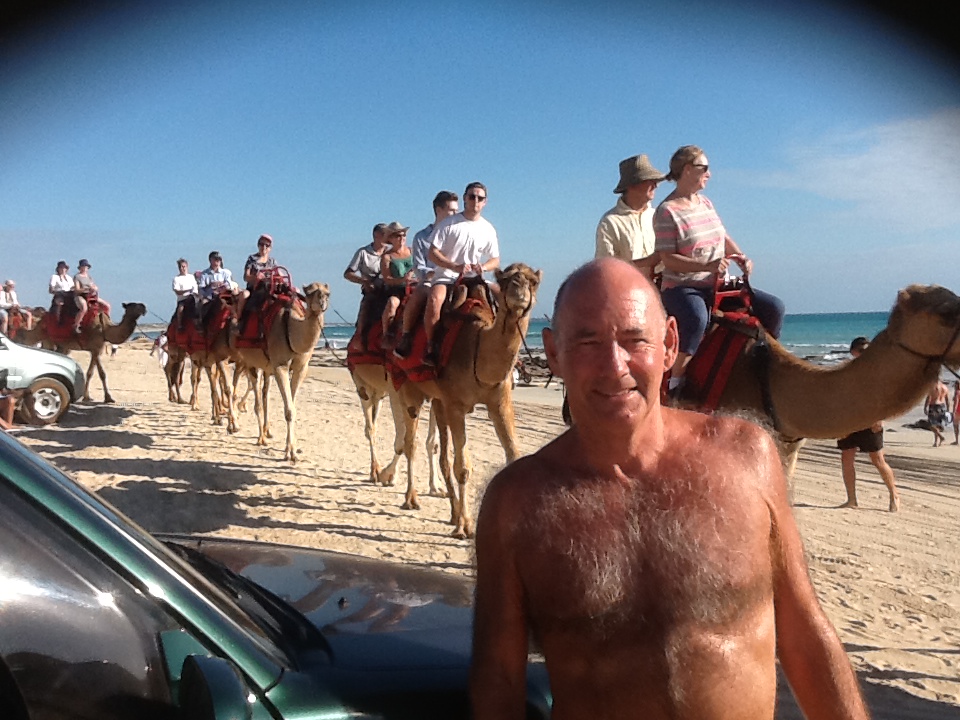
Steve and the camels!

Steve and the camels!

In the afternoons we have been greeted several times by camel trains close by – a favourite tourist activity is camel riding on the beach and especially at sunset. So far we have resisted this activity. The smell is enough to put you off!

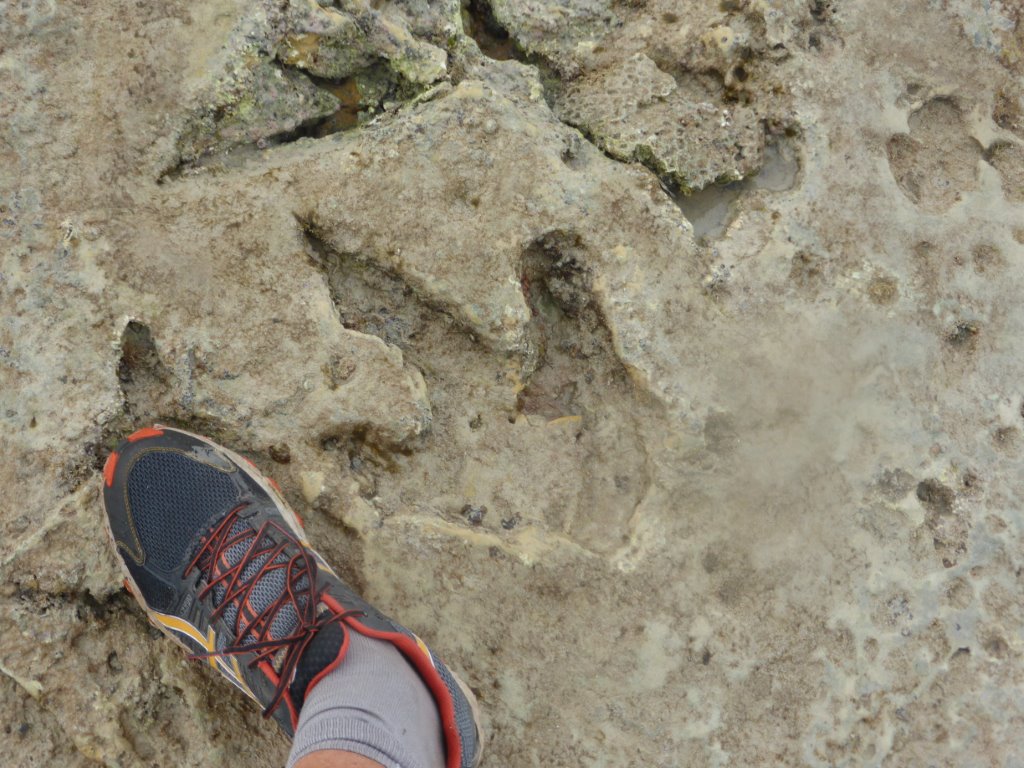
Last Friday morning we went off to hunt out the dinosaur footprints that can be seen at very low tides at Gantheaume Point. We climbed down the beautiful rich red but precariously slippery rocks and the small cliff from the lighthouse to explore the sandstone rocks, and there we found them….apparently 120 million years old dinosaur prints embedded into the rock.

A 120 million year old dinosaur print alongside Steve's foot so you can appreciate its size

A 120 million year old dinosaur print alongside Steve’s foot so you can appreciate its size

Along this coastline some 20 different species have been identified from embedded footprints, some up to 1.7m in diameter.

We expect to be here for another week enjoying consistently warm 30 degree sunny days and the delightful local hospitality before continuing on down the WA coast.

From Kununurra to Broome and tourquoise seas, white sandy beaches and more sunshine

After a very pleasant 6 days in Kununurra it was time to hit the road again, heading for the Bungle Bungles, to see from the ground these famous beehive-like domes in Purnululu National Park. The drive was very enjoyable, with varied landscape from sandalwood farms, to mining and cattle stations, passing through undulating ranges and valleys. We chose to stay at the Bungle Bungles Caravan Park, a relatively new camp ground (2011) on the Mabel Downs Station. It’s still a 53km drive to the Information Centre and then another ~20kms to any major walks from the camp ground. And what a busy little camp ground this is, playing host for one or two nights to many ‘caravaners and off-roaders’ who don’t want to take their vans or trailers on the  ‘amazing’ road into the Park.

I feel compelled to mention some facts about Mabel Downs Station. It is one of the Stations that form Yeeda Corporation,  traversing property from Broome to Halls Creek, 500kms away and then on to The Bungle Bungles. It’s hard to comprehend the scale of this significant holding with its 95,000 head of cattle and sheep. And complementing this is the facility they have opened up 1km off the highway for campers visiting the Bungle Bungles.

We travelled out to the Bungle Bungles with our Kiwi friends Therese and Kerry, and wow, what a trip!

The Bungle Bungles at ground level

The Bungle Bungles at ground level

We decided to take pillows and cushions to soften the ride – because this is one brute of a road. It is described as a metal road, but somehow they forgot to say ‘and all the metal has washed away, and it has huge corrugations that shake and rattle your teeth and your bones!’ We crossed 9 river/stream crossings, 5 with water up to the running boards. The road trip (return) itself took us 5 hours, and on our way in I did hear a number of times ‘this had better be good when we get there’. And it was. We visited Cathedral Cove, Piccaninny Creek, and also walked to The Window.

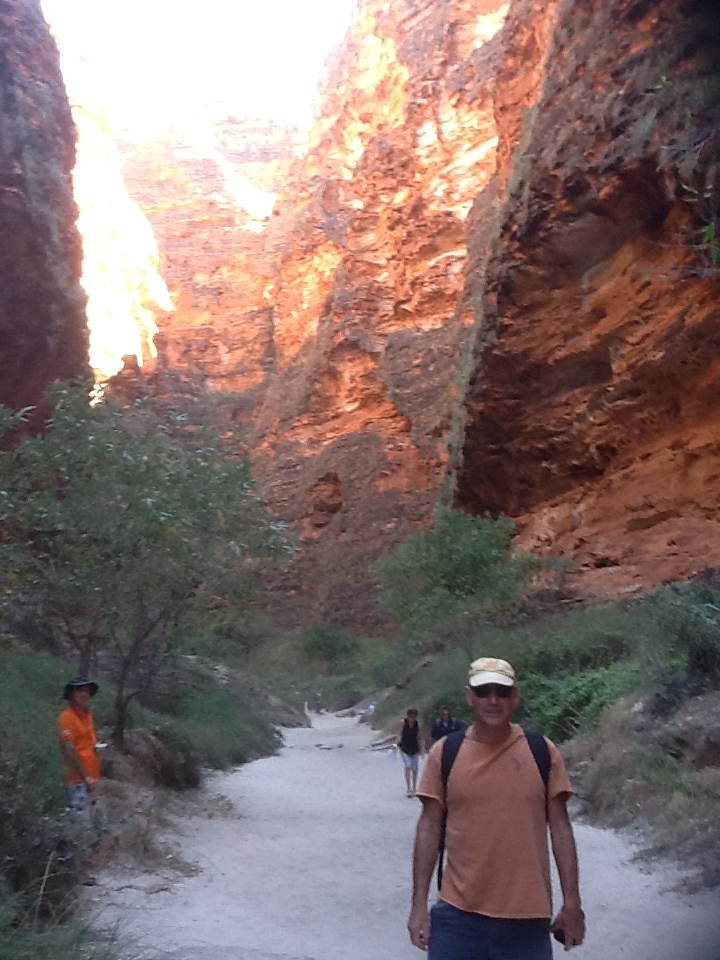
On the way in to the "Cathedral', Cathedral Gorge

On the way in to the “Cathedral’, Cathedral Gorge

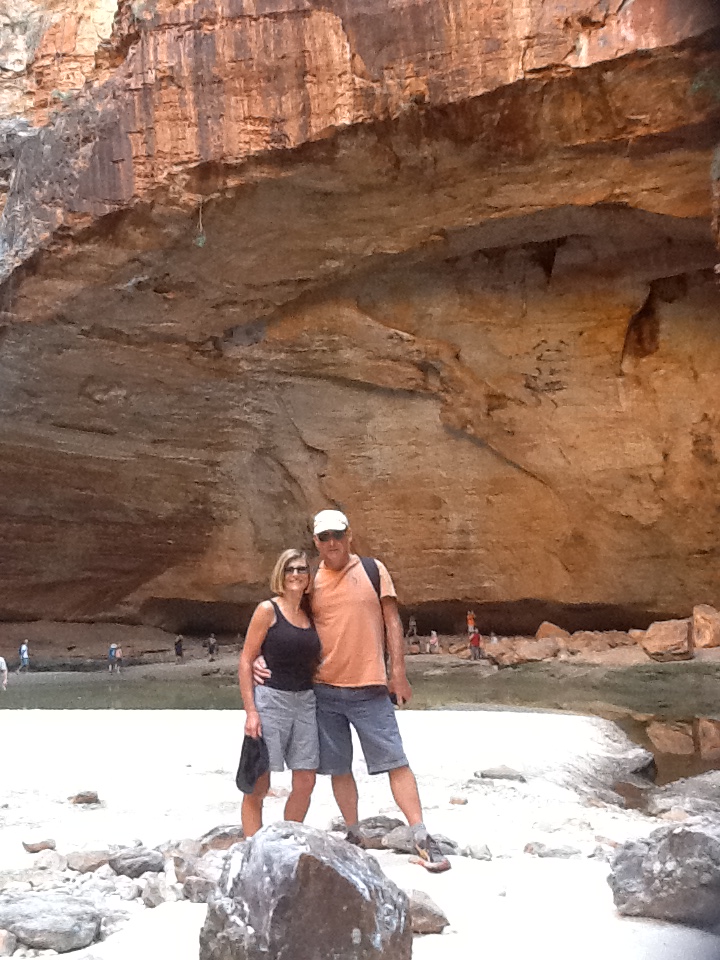
Cathedral Cove is at the end of a short walk through a hidden valley with 200+m domes rising up on either side, ultimately opening to an enormous cathedral like cove, where over millions of years water has eroded the escarpment to form the cathedral that sits over a large pool.

'The Cathedral', overlooking large natural pool

‘The Cathedral’, overlooking large natural pool

The escarpments of the domes tower high above creating an amphitheatre like environment. It is truly spectacular. To just sit and take in the surroundings was quite something.

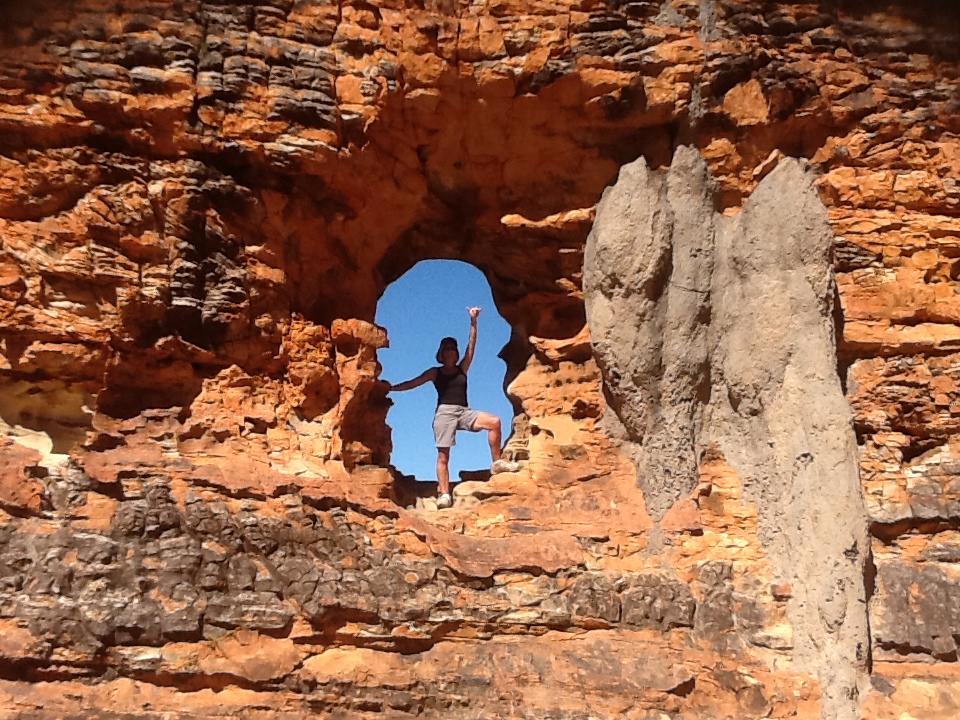
The Window walk is several kms up the Piccaninny Creek, where you can more appreciate the scale of the Bungle Bungles, passing the Sunset Lookout and ending at The Window, which is a natural window that has formed in one of the domes. The dried creek bed is quite staggering. It is largely rock, with many undulations and crevices formed over millions of years from the rushing waters of the annual wet season.

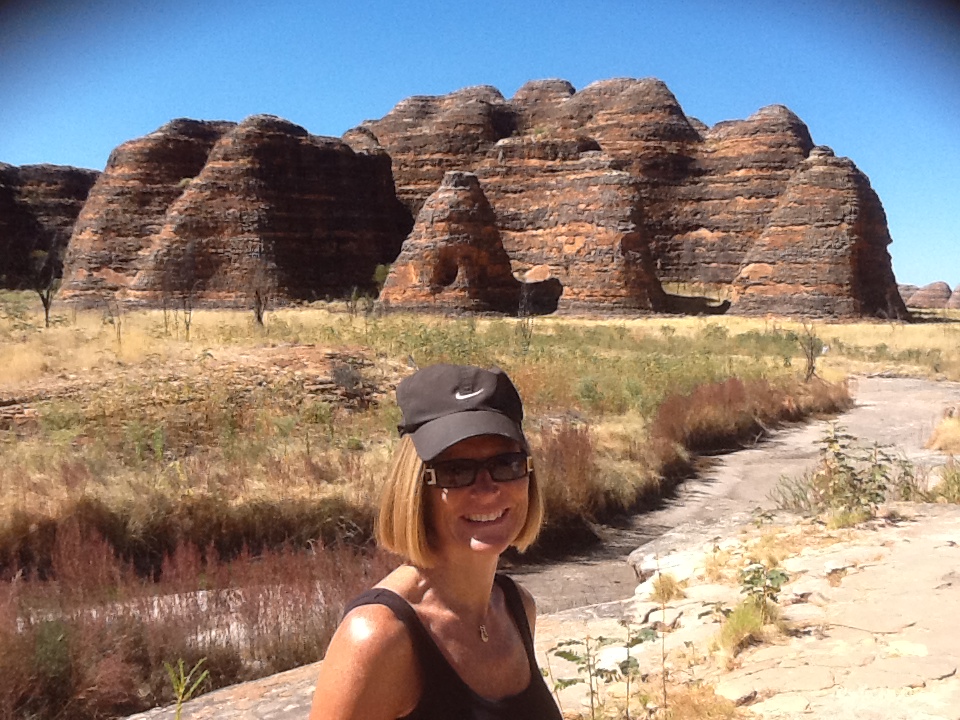
Jane 'posing' in The Window

Jane ‘posing’ in The Window

So, yes, it was worth it. Phew, just as well, because the return trip seemed longer and the corrugations some how grew bigger. We definitely needed a glass of red and a massage at the end of the day….well, Steve got the massage! It was an excellent day and we truly appreciated being guests of Therese and Kerry.

From here our next stop was Fitzroy Crossing, some 300kms away, and edging toward Broome and the East Kimberley’s. We stayed at the Fitzroy River Lodge, just before the town itself. This was an excellent grassed camp ground with very good facilities. The local attraction here is Geikie Gorge, which is close to the town. By all accounts it is very interesting, however with having been on so many excursions recently we decided to just relax, walk, bike ride and catch up on chores. We were due to stay two nights, but surprise surprise, after over 2 months of blue skies and sunny days it rained over night and with light drizzle in the morning we decided not to drive, but to stay and head to Broome the following day. So on Monday it was Broome here we come. This was a 400km day, on good roads and of course as it does in northern Australia, the sun shone again. We have booked 10 days in Broome, however think it likely we will be here for 3 weeks.

Our time at Kununurra

Well, we have had a busy time in this little town in the East Kimberleys that was established in 1960 to service the Ord River Scheme. There are some 6000 residents in the greater area, who today support local tourism, mining and a strong agricultural industry that has recently, much to the chagrin of many locals, extended to the development of large plots of Indian Sandalwood. On Thursday we relaxed and went for a bike ride. The following day we did a tiki tour around local sights. This included the Zebra Rock Gallery which features zebra rock, a fine grained siliceous clay stone with rhythmic patterns of red bands or spots contrasting sharply with a white background, found in Lake Argyle);

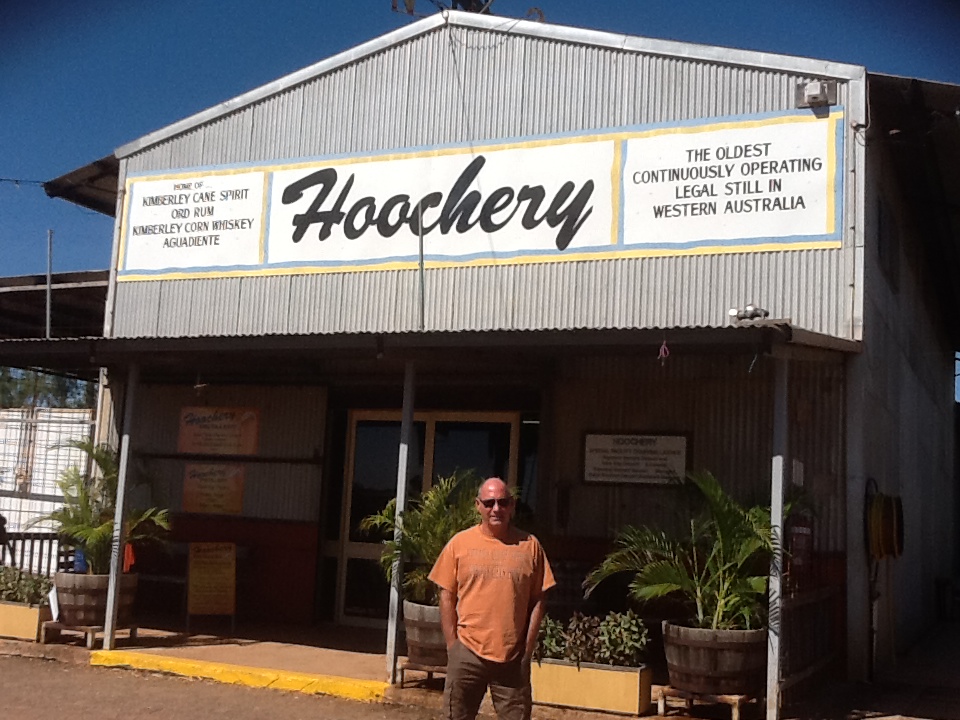
The Hoochery

The Hoochery

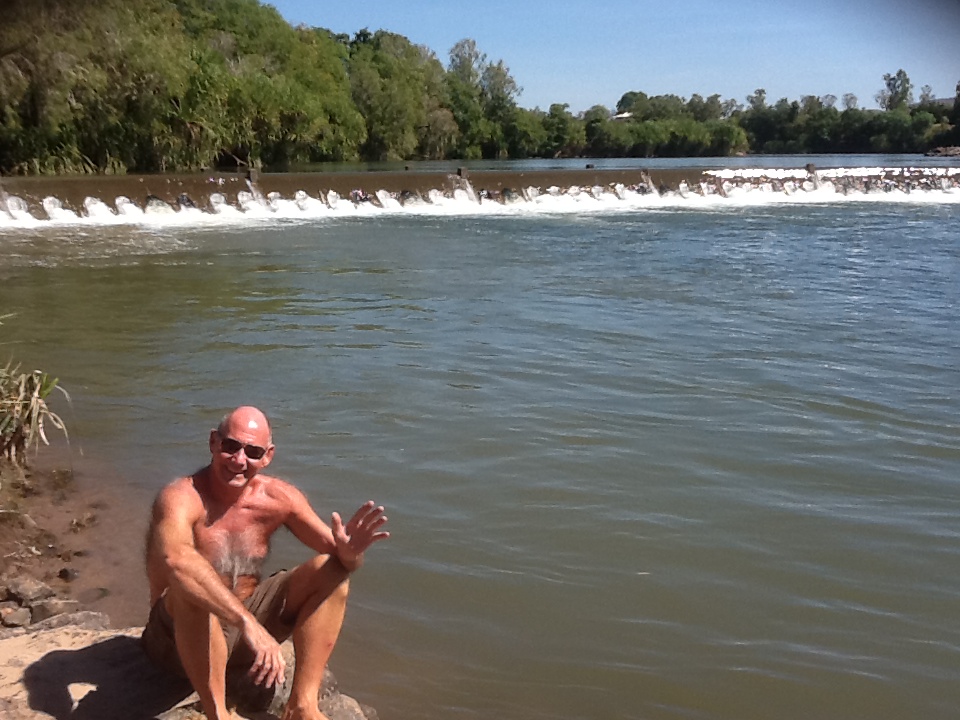
the Hoochery, the local rum distillery, the Sandal- wood shop where we learned about sandalwood and of course purchased some products; and the Ivanhoe Crossing, which is on the original Kununurra to Darwin road and is the old concrete causeway over the Ord River built in 1954. Sadly today it is closed to vehicles unless you want to tackle a huge boulder that blocks the crossing and then take on the fast flowing waters of the Ord, home to saltwater crocs and the mighty barramundi.

Ivanhoe Crossing

Ivanhoe Crossing

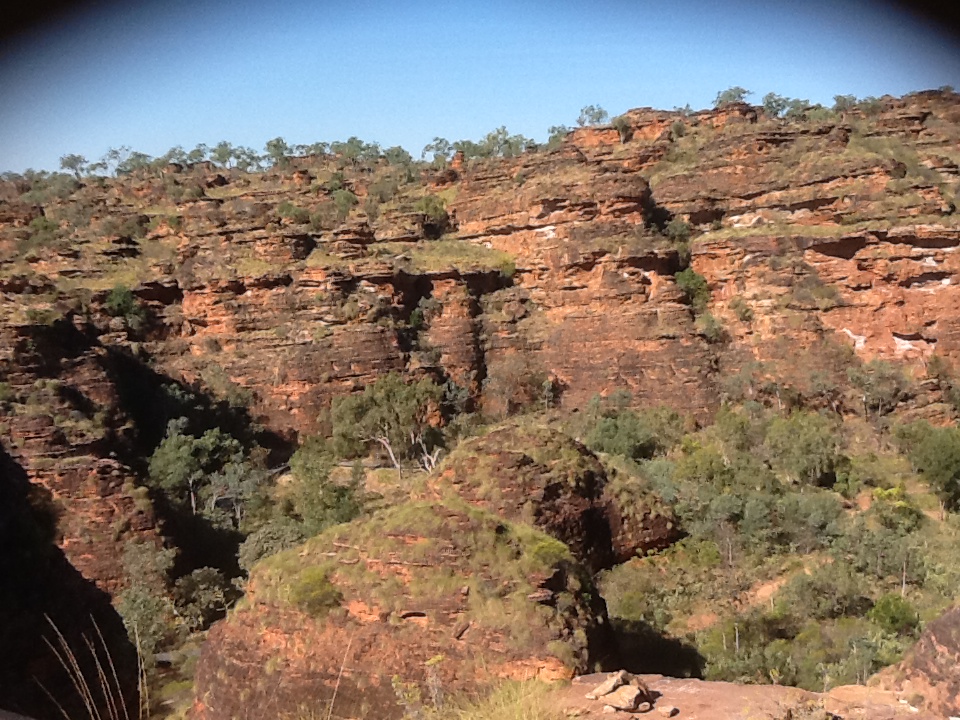
Then we visited the  Mirima National Park or Hidden Valley to look at the unusual sandstone formations that are known as the ‘mini Bungle Bungles’. They are amazing. We took our lunch and chairs and hiked to the top of the walk that takes you to the top of one of these formations so that we could sit and take in the beauty and then the views across the valley. They are truly majestic and so unusual!

The view from atop one of the domes in Hidden Valley

The view from atop one of the domes in Hidden Valley

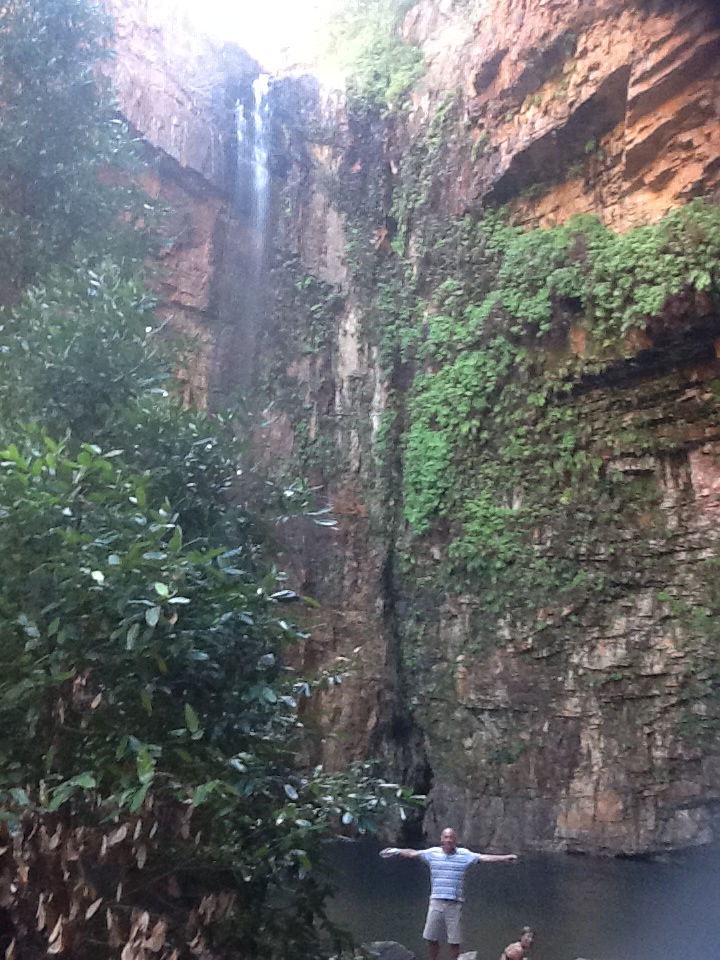
On Saturday our friends Kerry and Therese took us with them to El Questro. Over the years we have heard so much about the El Questro property and resort, seen stunning footage of this wilderness resort from helicopters on promotional TV programs and of course heard whispers of the per room rate. So this was a must on our agenda. Our first stop was the Emma Gorge Resort which is tucked away just a couple of kms off the Gibb River Road, on the El Questro property. What a stunner this spectacular gorge was. Following a 25 minute climb we came face to face with towering walls, plummeting waterfalls and a large waterhole that shimmered through shards of sunlight.

Emma Gorge

Emma Gorge

This was a delightful start to our day. From here we ventured further into the property and swam at the Zebedee Thermal  Springs which comprise lots of small pools surrounded by palm trees that create dappled light and excellent shelter from the heat of the day.

Our destination of El Questro caravan park and resort followed. After crossing several streams we arrived at the very well patronised caravan park. What a hive of activity this place was. Choppers flying in and out, a wedding breakfast being set up, campers in abundance. After a picnic lunch and conversation with locals to learn more we went to the Chamberlain Gorge and Jetty which is in a pretty spot….but with a beware of crocs sign, so no swimming here! This was the spot to get a view of the exclusive resort (we campers are not allowed at the resort!). Well, the consensus – disappointing. Of course we could only see the outside and some 300m away. When promoting the resort, which is on the top of a cliff overlooking the river, it has always looked like the escarpment is hundreds of metres high. Sadly its not! It might be 100 feet, but its not what we expected. That’s editing for you. With lots of disappointment we called it a day and headed home…..in reality we had a super day, with excellent company and one to truly remember.

Sunday we took a two hour scenic flight from Kununurra, across Lake Argyle, over cattle stations, down, around and over the magnificent Bungle Bungles that rise 300m from the desert, then over the Argyle Diamond Mine, home of the famous Argyle pink diamonds, along the Carr Boyd ranges (alongside Lake Argyle), over Kununurra and Hidden Valley, Ivanhoe Dam and the agricultural plateau and home again. How can 2 hours pass so quickly!

Looking out over Lake Argyle

Looking out over Lake Argyle

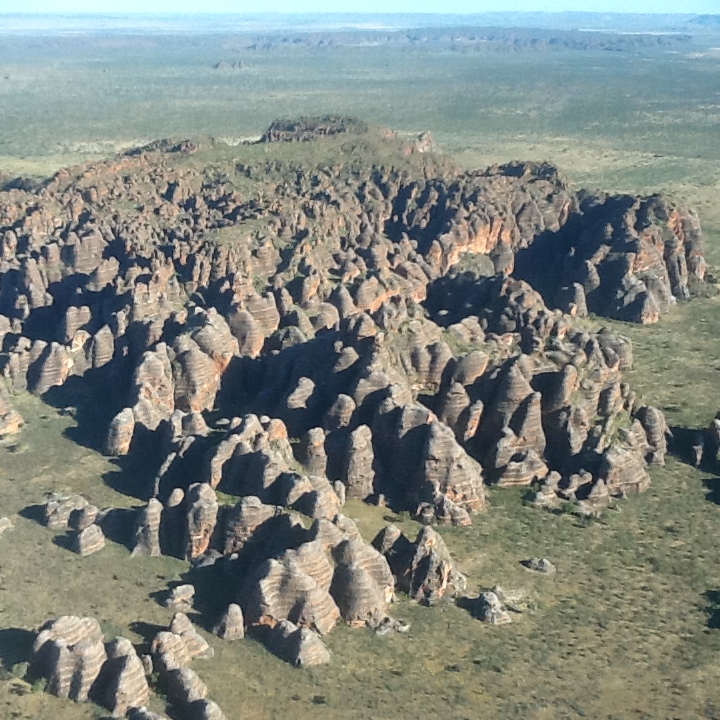
This is the only way to get a true perspective of the landscape. This region is truly quite stunning, with some of these ranges being amongst the oldest on the planet. The Bungle Bungles can only be described as inspiring and unforgettable. These orange and black striped domes have been formed over 350 million years. Truly amazing.

Looking down on the Bungle Bungles

Looking down on the Bungle Bungles

I will share more on these once we have visited on foot, and walked amongst the domes in a few days time. We were the only two passengers on our flight, so could ask lots of questions of our knowledgeable diminutive female Kiwi pilot, who has been in this region 5 months.

On Sunday we were both ‘choring’ when a large motorhome pulled up behind us, and it was our kiwi friends Rod and Dearne who have caught up to us again. So yesterday, Kerry and Therese took the four of us to Wyndham. We had been warned there wasn’t much to see, however we wanted to make a trip of it for the day. A 200km round trip, Wyndham is the last port northward before Darwin, servicing the huge cattle and mining industries of this region. The sights of interest for all of us included the 2000 year old Boab Tree in the local caravan park, which, if you do visit the little town is a must. It is quite something to dream and think of the experiences this tree must have had over time! There is a lookout 350m above sea level in the Bastion Range, overlooking the town and the five rivers of this region – the Ord, Forrest, King, Durak and Pentacost Rivers that all enter the Cambridge Gulf.

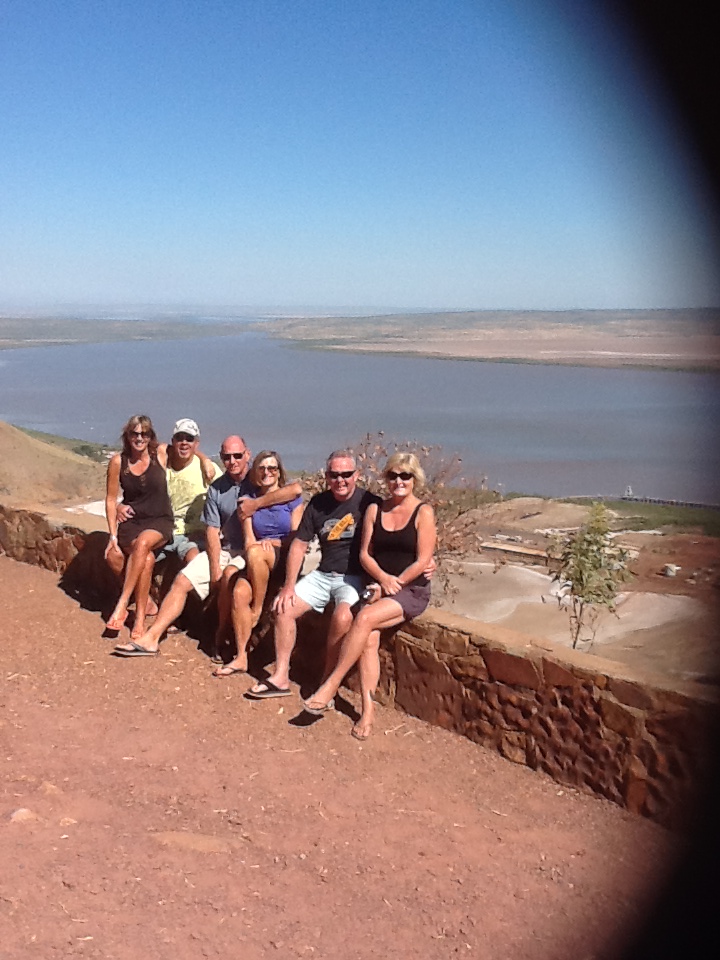
Six Kiwis atop the lookout in Wyndham

Six Kiwis atop the lookout in Wyndham

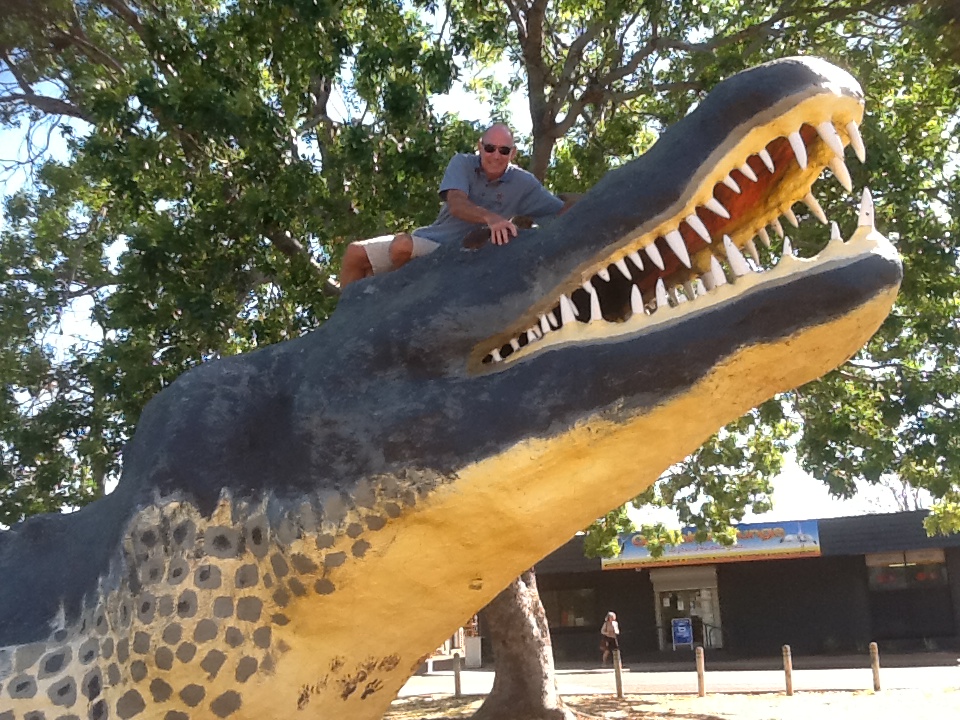
Because it is a working port and there is so much water in the river, it is muddy and unattractive at water level, hiding many saltwater crocs. Talking about crocs, there is a 20m concrete croc in town that is an attraction for many a photo!

Meet croc wrestler Steve

Meet croc wrestler Steve

Big kid Steve climbed aboard for a ride….We had a good look around, visiting historic sites and enjoyed lunch at the very busy local café in town before returning to Kununurra.

Tomorrow we head south to the Bungle Bungles, on our journey toward Broome.

From Northern Territory to Western Australia

When we left Katherine last Monday we had every intention of driving to Timber Creek and stopping there for the night. However because it was only 11am when we got there we made the decision to drive on to Lake Argyle. The drive from Katherine passes through more of Australia’s massive cattle stations, as well as beautiful national parks. We can now say that we have seen a cattle muster by chopper. 120kms south west of Katherine is the 422,550 acre Willeroo Station which is (unless recently sold) owned by the Sultan of Brunei, and is home to around 18,000 head of Brahman cattle. Those chopper pilots are amazing (or have a death wish), they fly so close to the ground during the muster. Another 75kms and we came into the Victoria River and Gregory National Park area. When driving 500+kms it makes such a difference to drive through magnificent scenery of escarpment ranges and strong flowing rivers. We really enjoyed this section of our trip. After refuelling at Timber Creek on we went, passing through the WA border crossing and on to Australia’s largest artificial lake by volume, Lake Argyle. With the time difference, we were set up and ready to investigate by 12.30pm.

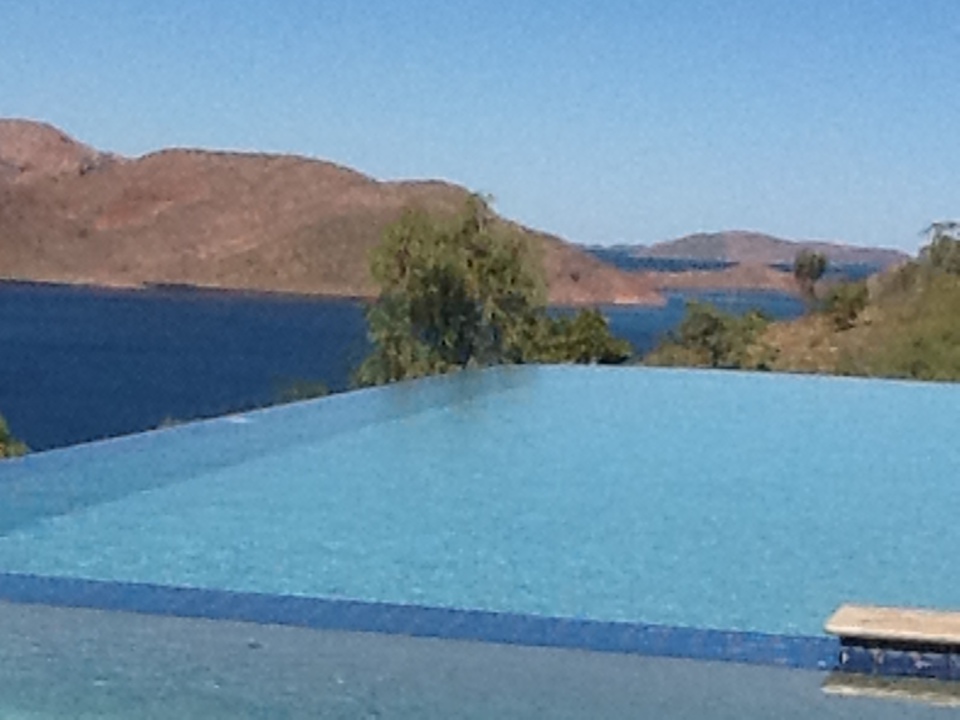
The camp ground at Lake Argyle sits up high on 5 acres overlooking the lake. Incredibly the view from the camp ground only takes in 1% of the Lake, and one of the best spots to enjoy that view is from the infinity pool sitting on the edge of the escarpment.

Looking onto Lake Argyle from the infinity pool

Looking onto Lake Argyle from the infinity pool

The Lake itself was formed in 1971 as part of the Ord River Irrigation Scheme. Millions of acres of farmland were flooded to hold a surface volume of 1,000 square kilometres in normal times. To put this in perspective it is 21 times the volume of Sydney Harbour (or 5.8 million megalitres) in the dry season and up to 88 times in the wet season.

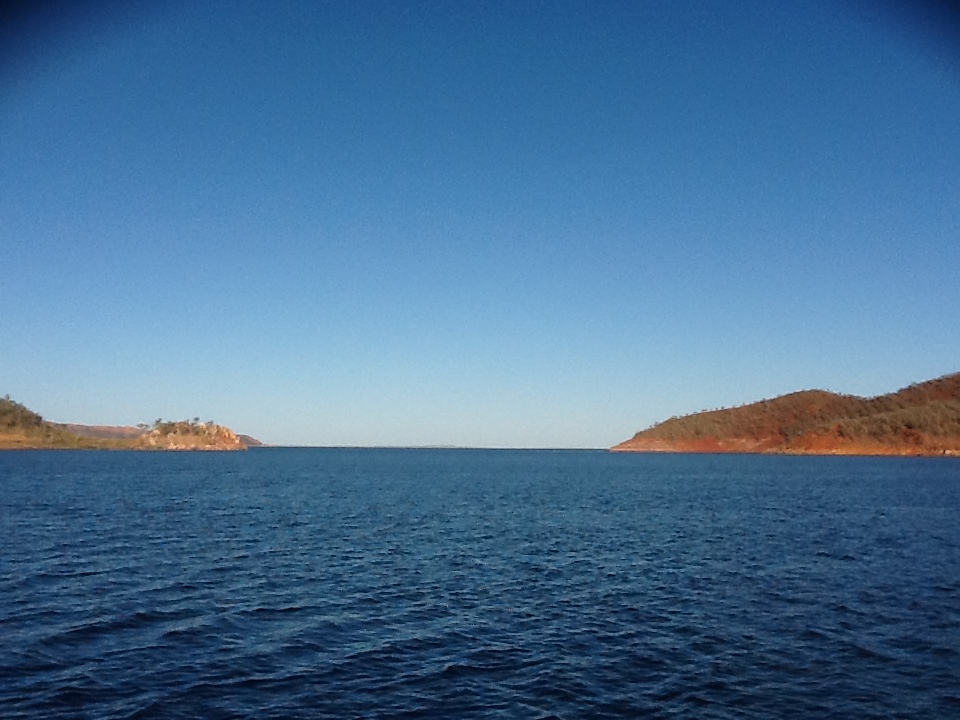
Looking across the Lake you simply cannot see land because of its size

Looking across the Lake you simply cannot see land because of its size

It makes for a beautiful vista, and the lake has become an important wetland area for bird life, as well as being the home to an estimated 35,000 fresh water crocodiles. Whilst at the lake we enjoyed a delightful sunset cruise that took us around various islands to see rock wallabies and kangaroos, feed various types of fish that inhabit the lake, see crocodiles basking in the sun, swim (fresh water crocodiles don’t find we humans at all appetising) and see the stunning colours of the evening sunset. At one stage when we couldn’t see land in the distance the skipper shared with us that the lake went another 35kms in one direction and 40 in the other.

Enjoying the sunset cruise

Enjoying the sunset cruise

Because we stayed three nights at lake Argyle, we also went on all the different walks from the camp ground. The most interesting was across the range to the Durak family homestead. The Durak family, originally from Ireland were real pastoral pioneers of the west, having come to Australia, initially settled in Queensland and then, traveling overland for 2 years in 1882-83 with 5000 head of cattle they established Argyle Downs station. Over the next 50 years their property totalled 6000 square miles, and it was their farmland that was flooded to form Lake Argyle. The old homestead was preserved and relocated a short distance from the camp ground. The history behind this family is preserved and shared at the homestead.

The Durak family homestead

The Durak family homestead

After three days it was time to head to Kununurra, a snip of journey, just 75kms from the lake. We have been based at the Discovery Holiday Park for 6 days, both because there is a lot to see here, and, we are parked right at the end of the campground, 3 metres from the side of Lake Kununurra, enjoying a beautiful and peaceful outlook and surely someone has to smell the roses!

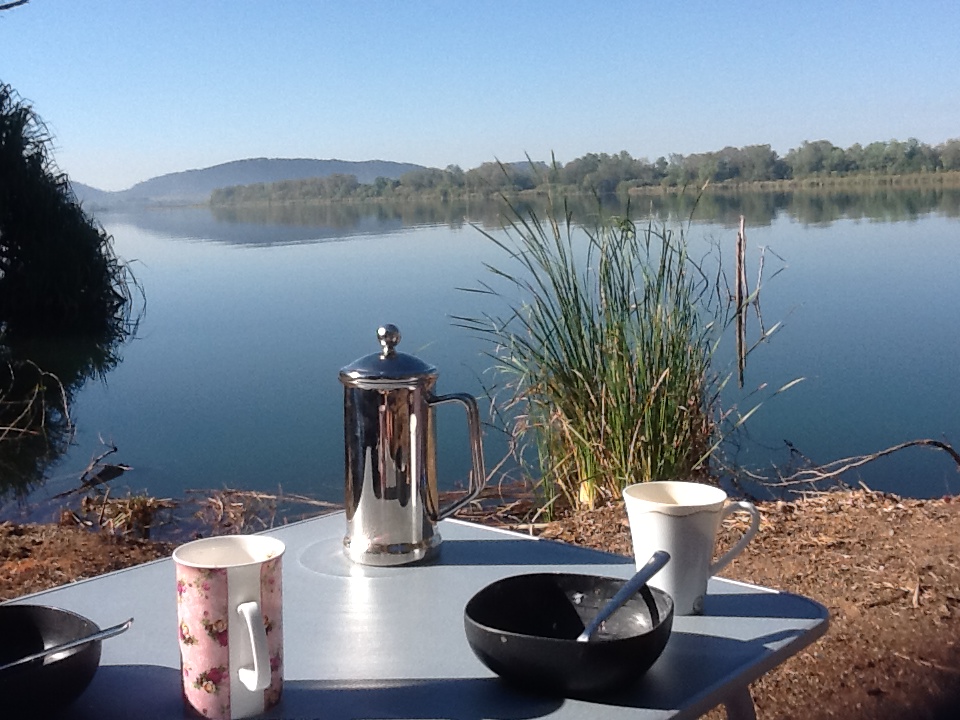
The view at 7.30am this morning from the breakfast table

The view at 7.30am this morning from the breakfast table

More delights of Kakadu

Cooinda is just 54kms down the Kakadu highway (and 59kms from Jabiru), so it was a quick trip from Jabiru to the Gagudju or Cooinda Lodge. Cooinda is the hub for many tours throughout the Kakadu National Park, especially the Yellow Water Cruise, a tourism award winning journey through Kakadu’s wetlands. It was also a great base for our visit to Maguk. The Lodge has an excellent camp ground, swimming pools and restaurants, and plays host to all types of traveller.

Once we had set ourselves up we embarked on our Maguk visit. Maguk is some 50kms south of Cooinda, and then 10kms on a lovely corrugated road (or maybe I should say dirt track) suitable only for 4 wheel drive. And you have to go slow or risk being beaten around somewhat. Following a 1km walk through monsoonal forest we came face to face with a beautiful and natural plunge pool at the bottom of an all year round waterfall. Steep gorge walls make this particularly picturesque. And at the top of the waterfall is the added delight of smaller crystal clear pools. Most importantly, there were very few people here which was a real bonus.

Enjoying a peaceful swim at beautiful Maguk

Enjoying a peaceful swim at beautiful Maguk

Like all ‘wet areas’ in Kakadu, there are the inevitable ‘beware of crocodiles’ signs. We certainly enjoyed several peaceful swims before making our way back to Cooinda.

The next day we had an early start for the Yellow Waters Breakfast Cruise.  We had heard very good reports about this particular cruise and we were not disappointed. Up at 5.30am, after a cuppa and a very light breakfast (we knew that breakfast wasn’t until 9am), we drove the short distance to the boat…..and along with close to 100 others, enjoyed a stunning 2 hours. The cruise starts in the Yellow Water Billabong, Kakdu’s most famous wetland, which is at the end of the Jim Jim Creek, a tributary of the South Alligator River, and then journeys out into the river itself. We enjoyed a sensational dawn, watching prolific birdlife set against the backdrop of the red sunrise,

Dawn at Yellow Water Billabong

Dawn at Yellow Water Billabong

and then as the cruise progressed, saw many of Kakadu’s 60 wetland bird species (Kakadu is home to more than 280 species of bird, which is over 1/3 of Australia’s bird species) including brolgas, pairs of jabiru, whistling ducks, sea eagles, magpie geese, herons, ibis, darters, wrens, pygmy geese, jacanas (lotus bird), bitterns, king fishers we have never seen before, various types of cormorants and lots of others!

South Alligator Wetlands

South Alligator Wetlands

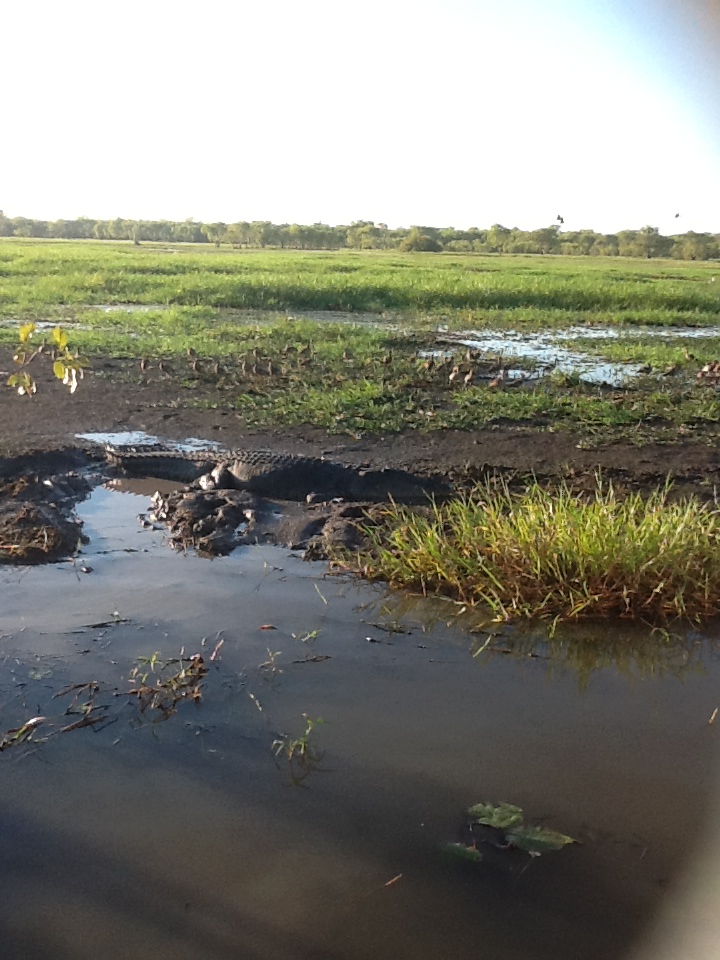
And of course there were turtles and big fat salt water crocs just eyeing us up as we cruised on by. I can’t really describe how stunning the wetlands area is with its vibrant life.

a 4m+ croc sunning itself less than 3m from the boat

a 4m+ croc sunning itself less than 3m from the boat

The colours, the sheer numbers of birds, and the absolute tranquillity. And all this against a backdrop of a highly knowledgeable and engaging guide who shared facts and stories about the local aborigines throughout the tour. This one is a must to anyone going to Kakadu. We didn’t want it to end! But end it did, and following a hasty breakfast we packed up and headed south, back down to Katherine.

We decided to have a few days of relaxation, and so have been here for 3 days, parked in the unpowered acreage of the Big4 at Katherine. They have a very large area where guests can choose where they want to park. So, we have found a spot where our closest neighbour is some 200m away. Other than bike riding, swimming, walking, chores and stocking up on essentials, this has been a very relaxing time. And of course we celebrated Steve’s birthday whilst we were here, and enjoyed a night out at the local onsite restaurant.

Tomorrow we start our journey west, with our next major stop at Lake Argyle and Kununurra, where we expect to enjoy the many activities and sights this region offers.


Out and about between Darwin and Jabiru

Last Wednesday evening, before we left Darwin, we joined friends at the casino for the State of Origin match, and of course I have to mention this because we are very happy that after an 8 year drought, NSW won the series…..and no, we haven’t yet changed allegiance to the mighty maroons. It was an excellent night, outdoors in 25 degrees, with another stunning sunset followed by excellent entertainment, just watching the fans, who all had a great night.

On Thursday we left Darwin around 8am and the beauty with no fixed plans is that you can change them as you go! Instead of going straight to Jabiru, we travelled only 100kms, stopping at a super little camp ground at Mary River Wilderness Resort and Caravan Park near the Mary River National Park. There are only about 26 caravan/motorhome sites, although they do let campers go to other areas in the green grassed park if needs be.  The hosts, (not the owners as we didn’t really meet them) Geoff and Deb are delightful people. The area is well set up and very close to the Mary River. We only intended to stay one night, but ended up being there for 3. We had a lovely time. Of course, seeing that there was a 4.30pm river cruise, we were in….and we were not disappointed. The river has the highest concentration of crocodiles in the world!

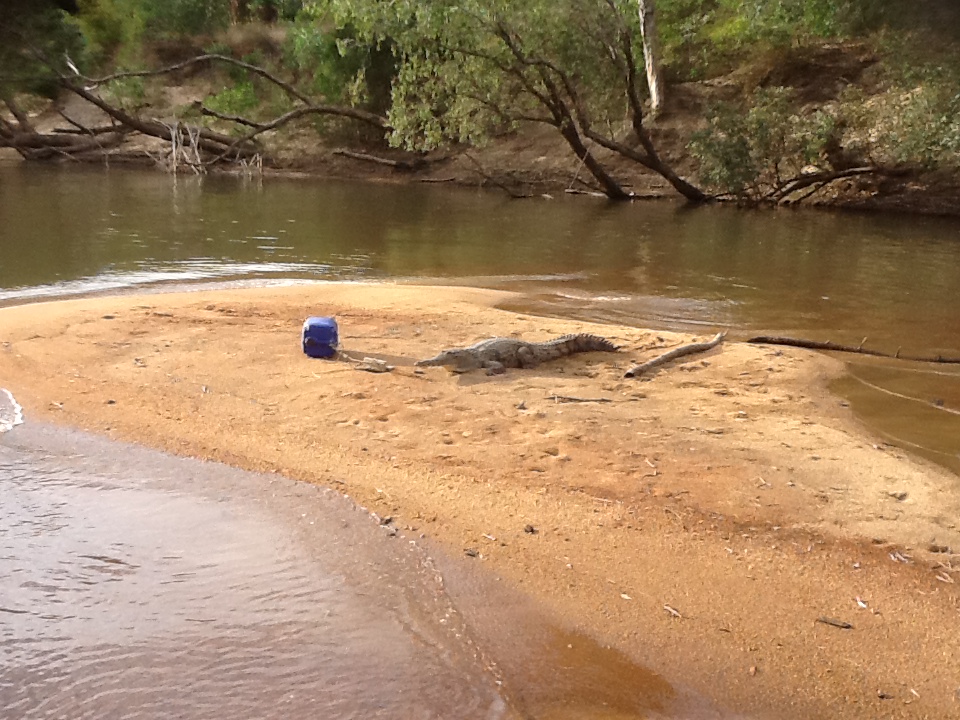
Saltie croc on sand island in Mary River

Saltie croc on sand island in Mary River

They say elsewhere there are 5 crocs per sqkm, and here there are 18 per sqkm, and I think we saw more than our share. Of course we expected to see fresh water crocs, and like most waterways in this region, there are salties as well, and these were big blighters, around 4m. We ventured down the river about 5kms croc spotting and snapping away madly, before then going 1km up the river from our entry point. Given its dry season we got to see lots of crocs and other wildlife. Further into the dry season the river will dry out more so that it becomes akin to a series of billabongs. In the wet season though, the water rages through the riverbed, up to 9m higher than we were boating. Under the road bridge there are huge tree trunks caught under the spans, demonstrating just how much water cascades through here in monsoon season.

Whilst at Mary River we went into the national park and visited Wildman Wilderness Lodge, an upmarket resort nestled away down an 8km dirt road, accessed by car, plane or chopper. This is a place to stay if you want some luxury and pampering whilst enjoying the treats of Kakadu and the region. Further into the park is Shady Camp,

Shady Camp Water Crossing

Shady Camp Water Crossing

with a river crossing where the salt water meets the fresh water, and both crocs and barramundi congregate at high tide. Its a great croc watching spot on the Mary River, with a special viewing platform if you want to sit, watch and wait quietly. We didn’t see any crocs, but did see lots of fish close to the crossing.

We made the most of our time here, and hired a boat for 3 hours and decided to try for an elusive barramundi. Alas, its still elusive and sadly swimming around with a lure in its mouth. My rod was bent into a u-shape with the pressure, the line took off and then with the pressure it snapped. A chap caught a 1.5m barramundi in the river just days before, perhaps this was the twin that got away. We did though enjoy ourselves, albeit we were very watchful the whole time with crocs on the banks in may spots along the river.

There were several walks on the Resort grounds, both good exercise and rewarding with wildlife and lots to see. The short 1.5km wallaby walk did indeed reward me with wallabies, and the 8km walk which we both enjoyed meanders along the riverside, inland alongside billabongs and through a bamboo forest.

On Sunday morning it was time to head to Jabiru where we are now. We have been in the Kakadu Resort caravan park. Now there have been many who have said Kakadu isn’t worth a visit. We can’t agree with them. Certainly Jabiru is a nothing town, thankfully though at least it has an IGA. The history here is that this is in fact a mining town, set up for and by the Ranger Mine in the 1970s. Ranger mine is a uranium mine that at one point supplied 12% of the world’s uranium (I’m not sure if that is good or bad!). Yesterday we enjoyed a fantastic scenic flight from Jabiru Airport with Kakadu Scenic flights. Its very hard to get any sense of perspective of the scale of the part, or to see any more than 100m either side of the road when driving around. This flight really does provide real perspective.

The East Alligator River from the plane

The East Alligator River from the plane

We flew over the huge Ranger Mine (the open cut mine is being filled in due to a pending change in legislation to underground mining of uranium); along the East Alligator River, one of the main rivers in this region; over the huge escarpment that runs down the length of the park and then up onto the plateau that forms Arnhem Land; over the Magela Wetlands, full of bird and fish life; and along the Minkinj Valley. The park is 20,000 sqm (half the size of Tasmania, and the whole of Switzerland). This flight covers just a corner but what an amazing corner, it is majestic and stunning and showed us just what many talk about but cannot be seen without a lot of time on the ground, or a flight like this one.

We also visited the Mamukala Wetlands yesterday. Now we had no expectations given our experience so much of the time with wildlife. Well, this time there was an abundance of birdlife. As well as the walk, we sat in the watch for half an hour and just watched – all different types of wetland birdlife.

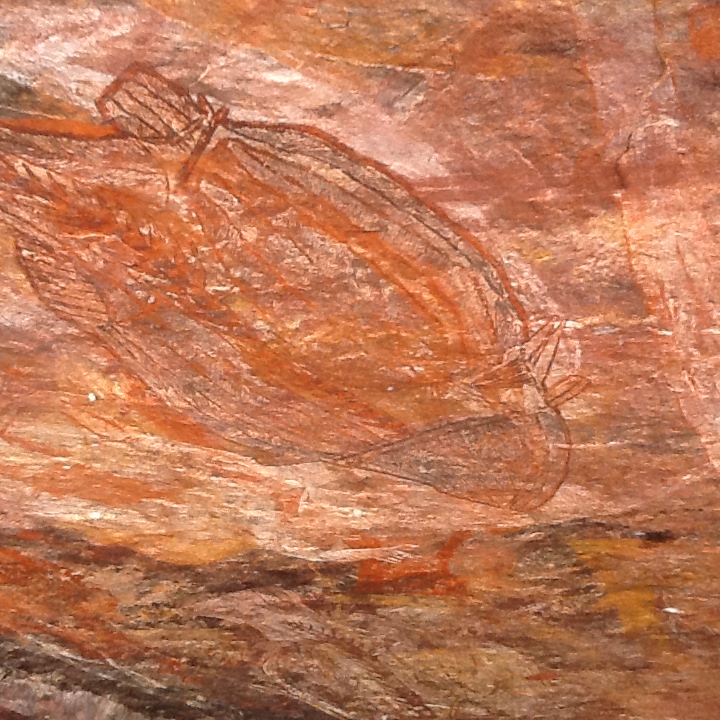
Today we visited Ubirr. What a magic, spiritual and stunning place this is. The drive to Ubirr features wetlands and huge sandstone escarpments and then once at Ubirr there is a small walk to some of Australia’s best rock art displayed in 3 main natural galleries, set amongst rock outcrops that sit on the edge of the Nadab floodplain.

Rock art

Rock art

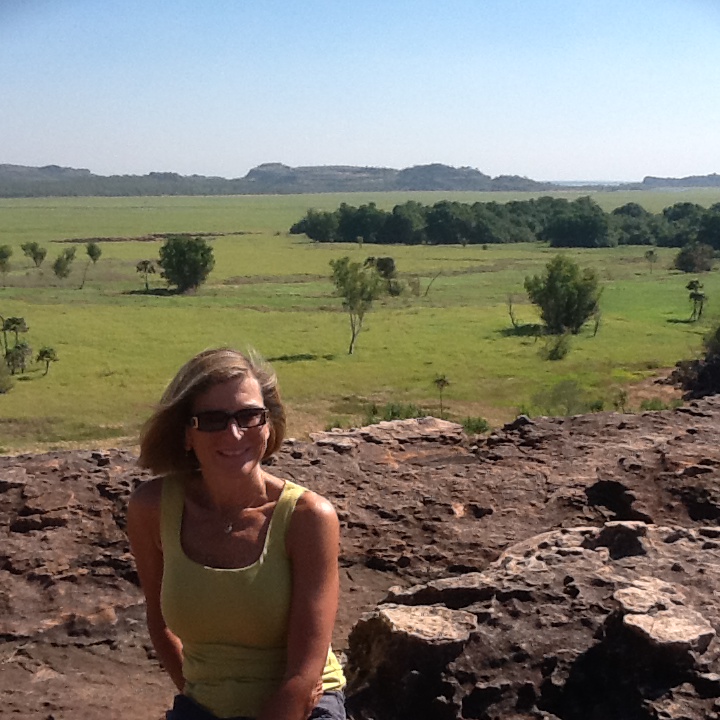
At the top of the Ubirr rock there is a panoramic view across the floodplains, the East Alligator River and the escarpments. We sat at top quietly taking it all in, appreciating just what makes this such a special place for the aboriginals who lived here for so long, and today’s custodians of this very special place. Whilst out in this area we also walked the Bardedjilidji sandstone walk through rock formations some 1500 million years old. This is a 2.5km walk through and around outcrops and escarpments and along the side of the East Alligator River. Today has been a thoroughly rewarding and enjoyable day.

From Ubirr Rock down onto the wetlands

From Ubirr Rock down onto the wetlands

Tomorrow we will move to Cooinda as a base, where we will visit Maguk and Yellow Water Billabong. Sadly, that elusive crocodile is still in Koolpin Gorge, so no tenting whilst in Kakadu.

Another week in Darwin

We have thoroughly enjoyed a second week in Darwin, taking in more of the local sights and attractions, and making the most of the local hospitality. Sailing has of course been at the front of the agenda, and we have now been out twice for late afternoon/sunset sailing in the harbour on friend Adam’s catamaran which he moors at Cullen Bay Marina, which is just 2 kilometres from Darwin’s CBD. The marina hosts some of the cities best restaurants, and it is fringed by some of Darwin’s most prestigious homes.

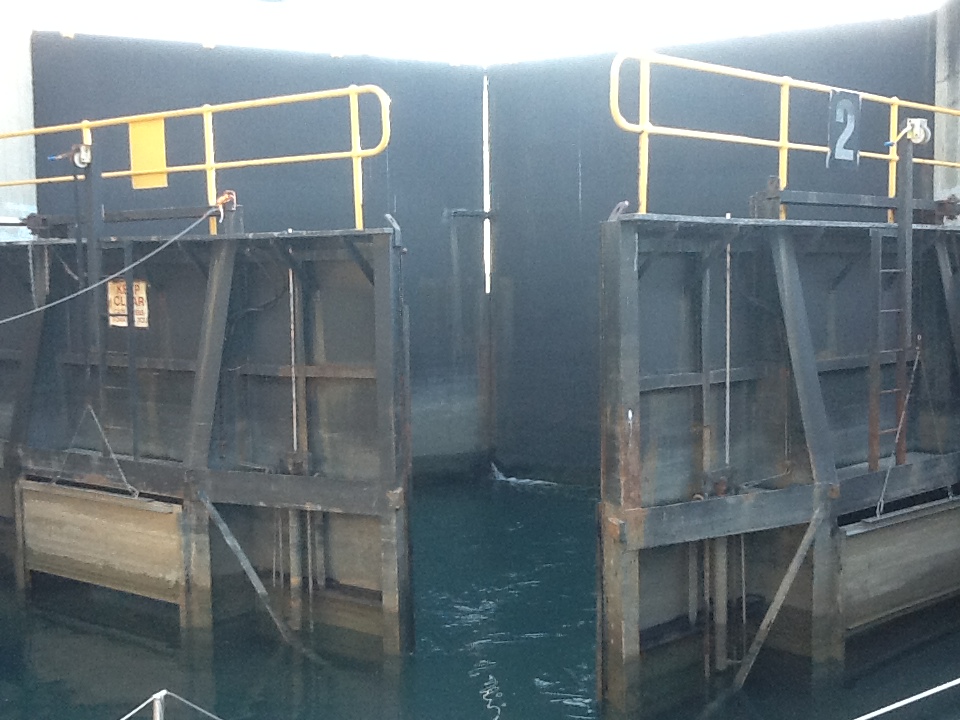
Cullen Bay Marina's lock system at work

Cullen Bay Marina’s lock system at work

But the most interesting feature for boaties, is that because of the significant tidal movement in the north, the marina is maintained at a constant level of 5 to 5.7 metres thanks to a huge 8 door lock system. Sailing in and out of the marina is an experience – and there is absolutely no sensation of water movement in or out, which can be thousands of tons depending on the tidal movement at the time.

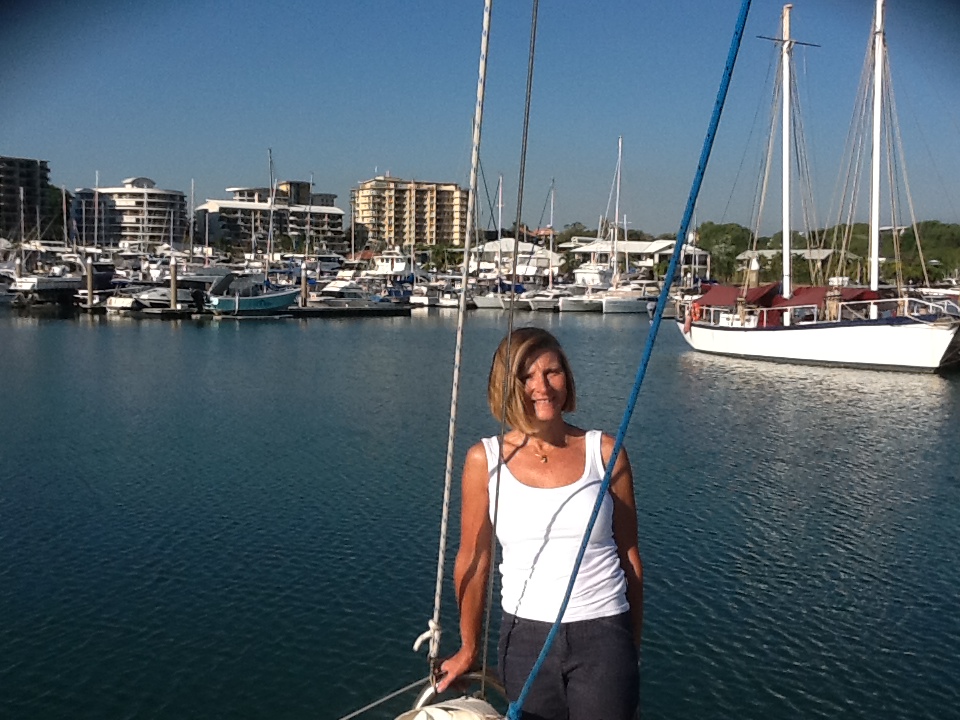
In the marina, looking across to homes and apartments

In the marina, looking across to homes and apartments

As you can imagine, it has been wonderful to back on the water, of course in stunning conditions, relaxing, then stirring to make the  occasional change in direction, tweaking a sail here and there, and meeting more of the locals who have also been out with us. On our first evening, we were treated to the soulful sound in the distance of piping – yes bagpipes at sunset – what a treat. We quietly sailed toward the piper, who we were surprised to see was a mature female, on the back of a very nice catamaran moored in one of the bays.

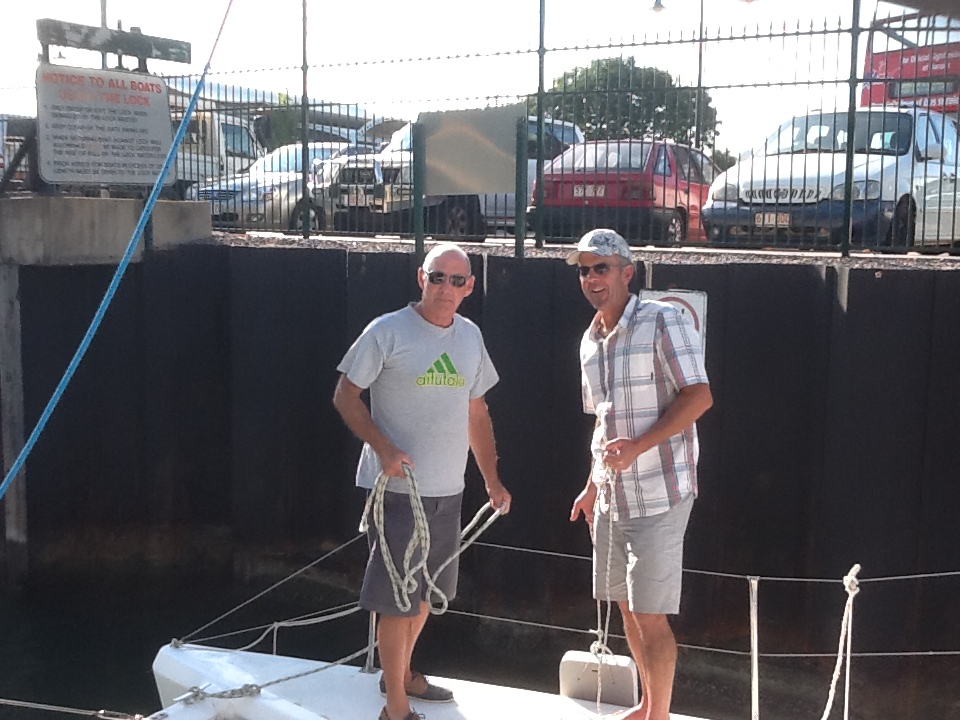
In the lock - Steve and Kerry about to tie the boat to the lock wall

In the lock – Steve and Kerry about to tie the boat to the lock wall

We had to have another treat for our second sail, and lady luck must have had us in her sights. I was off for a cycle, and only got as far as the back of the camp ground and there were our friends Therese and Kerry (who live in Tauranga, and who have been travelling a few weeks behind our schedule) who had just arrived in town, and who had cycled from their camp overs to ours to announce their arrival. So, they joined us for our evening sail. It was lovely to catch-up and learn more about their exploits over the last month or so.

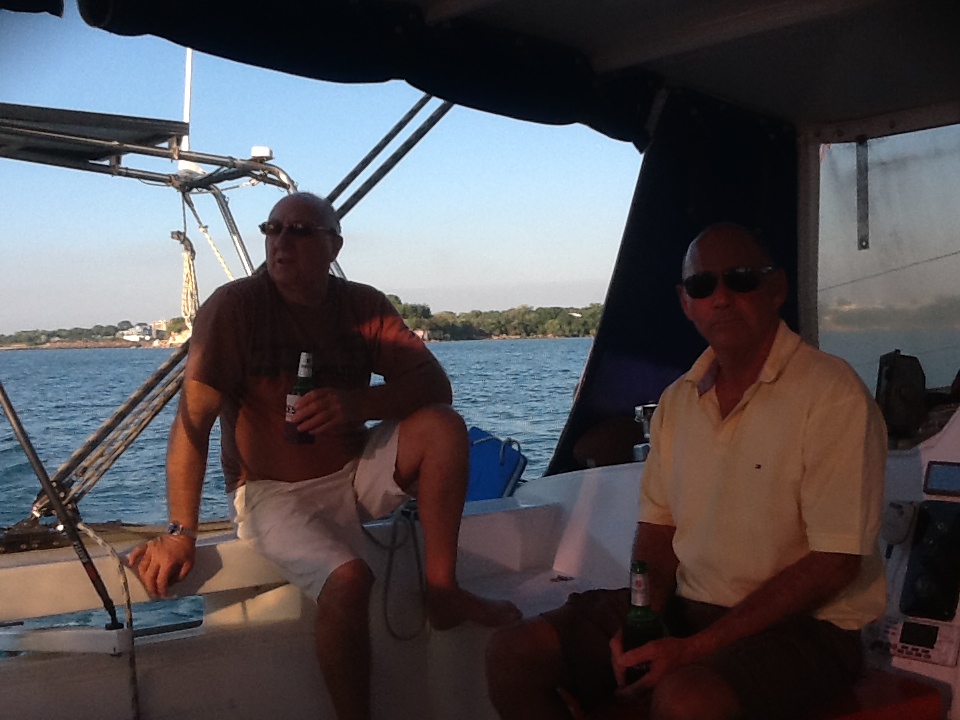
Steve and Adam, relaxing on the back of the boat - its a tough afternoon!

Steve and Adam, relaxing on the back of the boat – its a tough afternoon!

Getting a cultural fix when travelling can be challenging! We have been lucky, and spent an evening at live theatre at Brown’s Mart Theatre in the city, seeing a play called The Hoist (for the Aussies that read this, yes, this means the good old Hills Hoist, which was the main prop mid stage), which was the winner of the NT Literary Award 2013 – Best Script. Because its an intimate theatre, we also got to meet the playwright and chat with her for 10 or 15 minutes.

Several days ago we visited Berry Springs Nature Reserve, which is about 45kms south of where we are staying. There are many different springs and rivers in the NT, and what makes this so attractive is crystal clear spring water that is warm and flows into several levels of natural swimming pools that are surrounded by lush bush and lots of bird life. Not far from here is the Darwin River Dam, Darwin’s major water source, where the water flow can’t be regulated. It covers an area of 3,400 hectares and is just like an inland sea. What fascinated us is that there are signs all around announcing ‘Crocodile Safety Danger – Crocodiles live in the dam’. In other words its no different than the rivers and waterways all around the Territory.

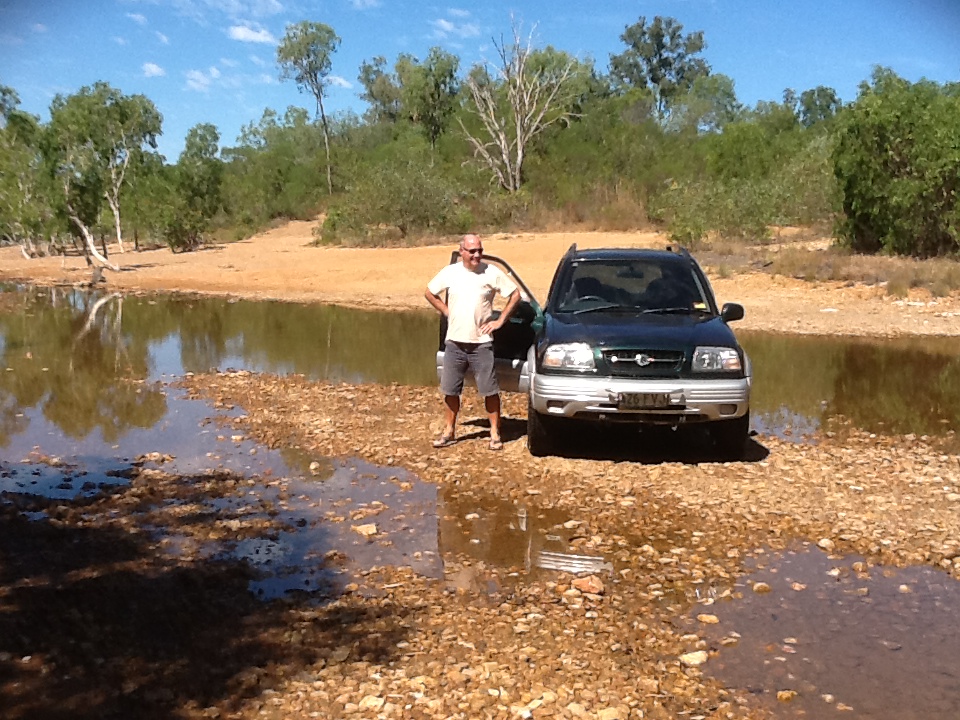
Whilst out exploring, we found a four wheel drive river crossing, so of course we had to have a play! Steve couldn’t resist and it is good practice for future ventures.

Finally, a river crossing!

Finally, a river crossing!

Yesterday and today we have been getting the Suzuki serviced because the air conditioning system is dying and that’s not good in this part of the country. We did have it back for the evening yesterday so that we could enjoy another meal at the Darwin Yacht Club with friends and hopefully it will be back to new later today. We plan to go into the Casino tonight, to watch the State of Origin game on their outdoor big screen. And then its pack up and hit the road tomorrow morning, heading for Jabiru and Kakadu. We have applied for a permit for the remote Koolpin Gorge and hope on Monday and Tuesday that we are able to four wheel drive in and camp for a couple of nights so that we can experience what many say is one of the best attractions in Kakadu. It will though depend on whether or not they manage to trap the crocodile that is there! National Parks will not open camping areas like this unless they are absolutely sure they are croc free. Because there were late rains this year, trapping is a little later than normal. Needless to say we are very supportive of their approach to safety with crocodiles. We’ll be out of contact for some of time whilst in the national parks so the next update will be when we have good coverage again.